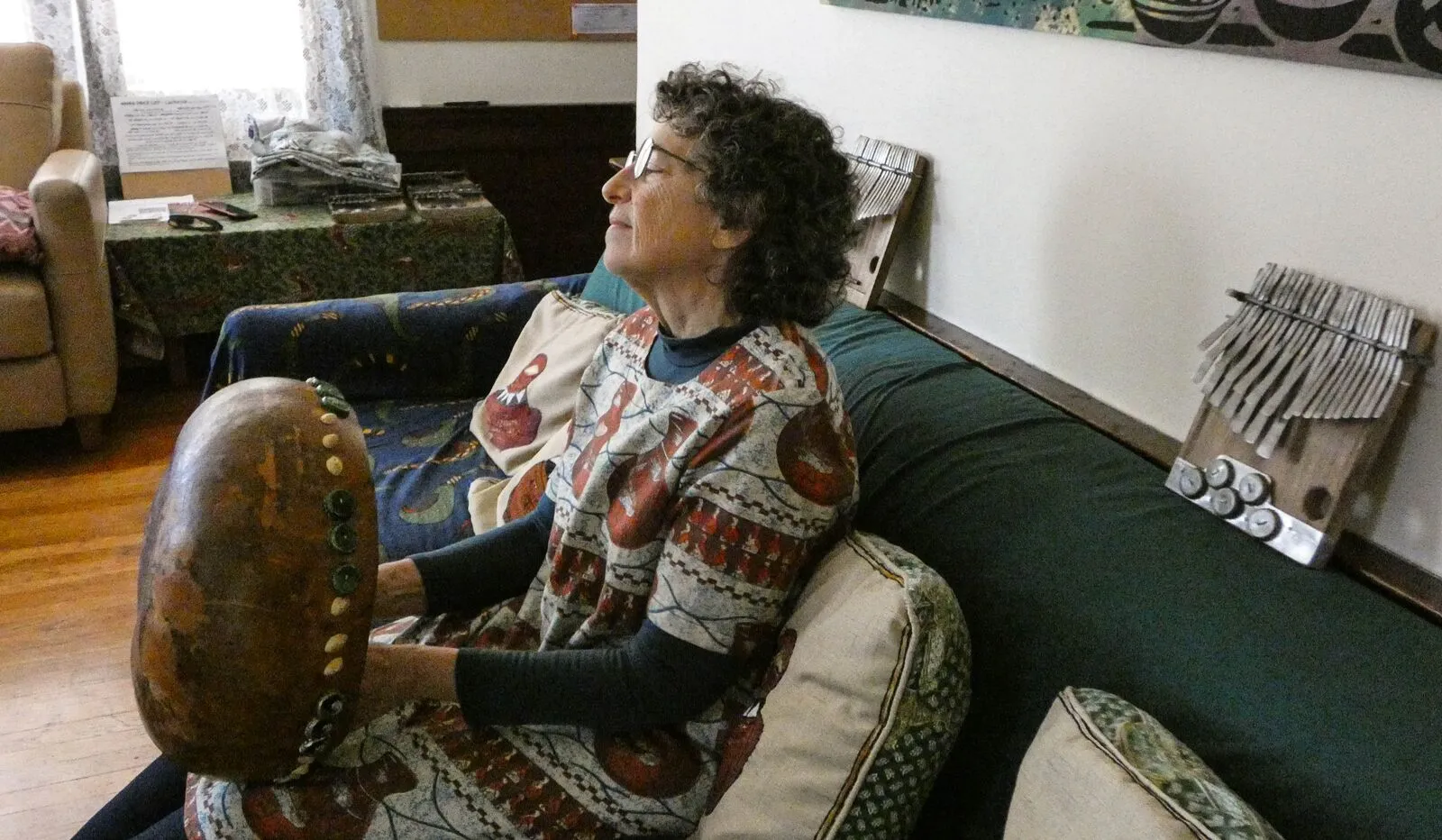
Because traditional songs, scales and mbira tunings often vary village to village, there’s tremendous variation in mbira.
Azim has studied and performed with many of the art form’s most revered practitioners, including Ambuya Beauler Dyoko, Fradreck and Fungai Mujuru, Irene Chigamba, Vakaranga Venharetare, Patience Chaitezvi, Renold and Caution Shonhai, and Leonard Chiyanike, most of whom she’s also presented in concerts in the U.
Her own approach is both deeply traditional and broadly cosmopolitan, encompassing many of the different mbira influences she’s absorbed. “She’s as knowledgeable as anybody in the U.
S, a true scholar, and I think her passion is to preserve the culture and help the people who can extend the culture and teach it to their people,” said Berkeley composer Todd Boekelheide, who produced Azim’s 1992 albumMbira Dreamsand has long served on MBIRA’s board of director.
Boekelheide explained his abiding love of mbira as flowing from “its inherent power. ”
“The music is spiritual,” he said, “and draws you in with apparent simplicity.
It’s played with only three digits on two hands, but sounds like a symphony, like 10 people are playing because of how the notes interact.
Over the eons folk music sheds anything that isn’t an authentic expression of something that’s deeply, powerfully true. ”
Part of the struggle in preserving traditional mbira music is that it’s endangered at home, and not just by the devastated economy.
Like in many societies, the allure of Western pop music and electric instruments captures the attention of many young people.
And there’s little support for traditional arts within the government.
On her last trip back to Zimbabwe five years ago, Oakland-based dancer Julia Tsitsi Chigamba noticed that young people are increasingly blending traditional mbira with hip hop, jazz and music from church, while nonprofit organizations provide some access to instruments and instruction.
The Zimbabwe-born artistic director and choreographer ofChinyakare Ensemble, an East Bay-based Shona dance company that performs often at Ashkenaz, was a girl growing up in a highly musical family when she first met Azim, who came by her village to record her father (mbira master Tute Chigamba).
Since moving to the Bay Area in 1999, those recordings help her feel connected with her family back home. “She’s doing amazing work,” Chigamba said. “When we see those CDs, it reminds me what I was doing then.
She still does a lot of work with my father.
When she sends payments to people it’s distributed from my father’s house, and it’s beautiful to see that.
She is the mother, and I knew her before I came here. ”
Azim was a precociously gifted student growing up in Berkeley in the late 1960s when she first heard mbira while auditing an ethnomusicology class at Cal. 🔗 Read Full Article
All Zim News is a central hub for all things Zimbabwean, curating news from across the country so no story is missed.
Alongside aggregation, our team of nationwide reporters provides real-time, on-the-ground coverage.
Stay informed and connected — reach us at admin@allzimnews. com.
