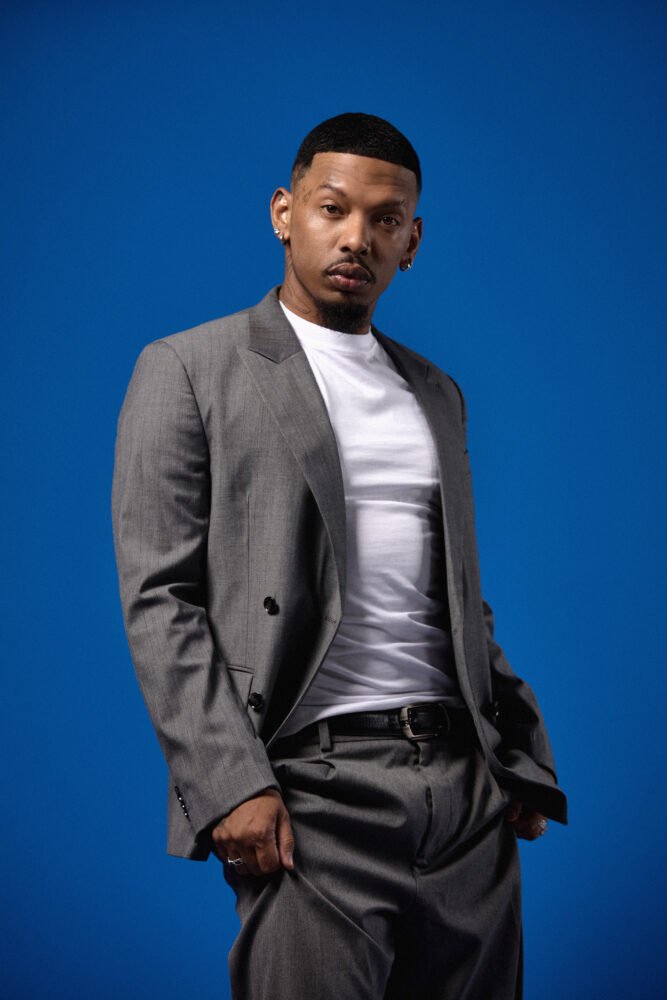
There was a stillness about him that night — one that did not announce itself with bravado but with something far more arresting. A quiet, emotional poise. When Lee-ché Janecke, known to the world as Litchi HOV, stepped onto the stage to accept the Standard Bank Young Artist Award for Dance, it was not just a career milestone.
It was a moment thick with memory, lineage and a kind of arrival that felt both deeply personal and historically loaded. An internationally recognised choreographer, creative director and movement architect, Litchi HOV has built a reputation for crafting visually striking, emotionally charged performances that move seamlessly between stage, film and global pop culture. His work, often rooted in storytelling and physical expression, has travelled across borders, placing him among a new generation of South African artists reshaping how dance is seen and experienced.
In the audience sat his mother, his sister, his people. The ones who had witnessed the long arc of becoming. They urged him gently but insistently to tell his story, not just of success but of resilience, of movement, of breaking what he calls “generational curses”.
Read Full Article on Mail & Guardian
[paywall]
A few days later, when we speak the same emotional clarity lingers in his voice. He is reflective, grounded and acutely aware that what he carries is bigger than himself. “I only found out later,” he says, “that both my parents were dancers.” It lands almost like a revelation in motion.
Growing up, dance was not formally named as inheritance but it lived in his body nonetheless. “There was always this natural pull to movement,” he explains. “My academics were great,” he says, “but this thing, this passion was louder.” Choosing dance was not just about career direction; it was a decision that would shape the architecture of his life.
Dance, as many practitioners will tell you, is often a selfless discipline. It demands the body, the spirit, the time, sometimes without giving much back. I ask him if he has ever considered walking away, trading it all for something more stable, more predictable.
He laughs softly but there is weight beneath it. “Of course those moments exist,” he admits. “You feel them.
You see other people give up but for me, quitting has never been an option. Not because it hasn’t been hard but because of what the choice to stay represents”. “I made a commitment,” he says.
“Not just to dance but to breaking something. To not going back.” There is a sense that returning to a safer, more conventional path would feel like a kind of betrayal, not just of the work he has done but of the younger version of himself who chose this life despite the odds. “It wouldn’t satisfy the child in me,” he says.
“And it wouldn’t mean anything now, after everything.” What sustains him then is not just discipline but perspective. He speaks about learning to sit with emotion, the highs and the inevitable lows. “You carry everything,” he says. “But you learn how to move through it.” It is a dancer’s philosophy, yes but also a life one.
[/paywall]
All Zim News – Bringing you the latest news and updates.
