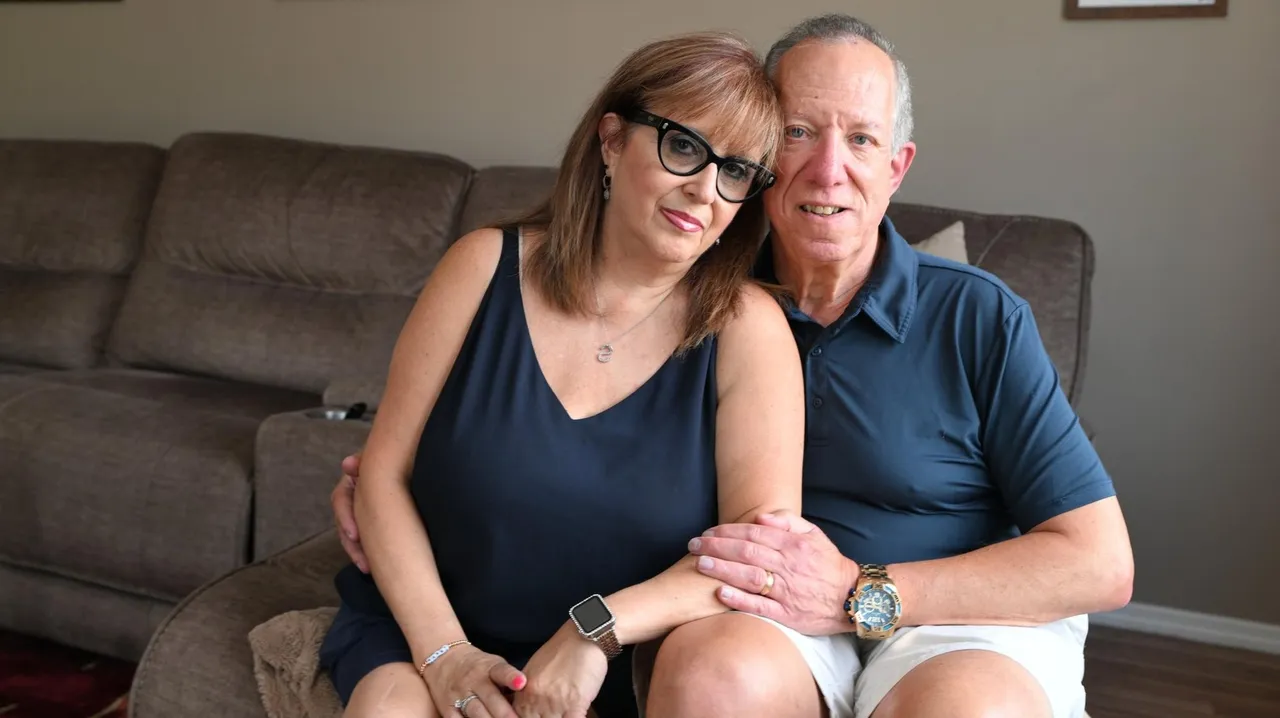
Sheryl and Ira Kleiner in their Middle Island home on Saturday They say a rapid, accurate blood test might have helped them.Credit: Elizabeth Sagarin
ByNicholas Spanglernicholas.spangler@newsday.comspanglernewsdayUpdated July 28, 2024
A blood test for biological markers of Alzheimer’s disease could open the way for faster, cheaper diagnoses, according to a new study “A blood test could identify patients much earlier on,” said Dr Nikhil Palekar, director of the Stony Brook Center of Excellence for Alzheimer’s Disease and of the medical center’s Alzheimer’s Disease Clinical Trials Program
As research into Alzheimer’s treatment advances, Palekar, a board member of the Alzheimer’s Association’s Long Island Chapter, said: “If we can find patients who have no cognitive symptoms and treat them early enough, it’s reasonable that we can completely stop the symptoms from developing.”
Researchers found the blood test for the biomarkers was around 90% accurate in identifying Alzheimer’s, while without using it, specialists were 73% accurate and primary care physicians 63% The research, funded in part by the Alzheimer’s Association,is publishedin the Journal of the American Medical Association WHAT TO KNOWA new Alzheimer’s study says blood teststhat accurately and reliably detect changes in the brain could yield simpler, earlier diagnoses.The blood test was more accuratein identifying the disease than diagnoses by doctors who did not use the blood test, the study said.Experts say that for the time being, doctors should usea combination of cognitive and blood or other biomarker testing for Alzheimer’s Early diagnosis is the Holy Grail of Alzheimer’s research because, in theory, treatment could halt the irreversible, fatal disease before it causes brain damage
There is no cure for Alzheimer’s, but there are medications to manage its effects and slow cognitive decline in people with the disease They are only approved for use in patients with early-stage Alzheimer’s and may carry safety risks of their own Get the latest stories every week about health and wellness, covering topics from medicine and mental health to updates on the coronavirus and new research By clicking Sign up, you agree to ourprivacy policy
The United States Food and Drug Administration on July 2 approved one of them, donanemab Last year it approved a related drug, lecanemab It also approved a related drug, aducanumab, which is no longer being marketed They belong to a class of drugs known as anti-amyloids that have shown modest but statistically significant effects in slowing progression of the disease
Widespread use of a blood test for Alzheimer’s could be also be a boon for researchers if it expands the pool of asymptomatic patients for clinical trials, Palekar said It could also help doctors better stratify patients with cognitive complaints, flagging those who tested positive for fast follow-up by specialists, a wait that can now take up to nine months, Palekar said “This is a real issue for Long Island,” he said “The big problem is how we are going to diagnose patients.”
Alzheimer’s Association researchers estimate there are close to 62,000 Long Islanders living with Alzheimer’s, a number that could grow as the region skews older
Dr Sebastian Palmqvist, a researcher at Lund University in Sweden, was the study’s lead author Another Lund researcher, Dr Oskar Hansson, was senior author
The study followed 1,213 patients: 515 in primary care with a median age of 77, and 698 in specialist care at memory clinics with a median age of 74, the two wrote in an email Source: NewsDay.com
All Zim News
All Zim News is a central hub for all things Zimbabwean, curating news from across the country so no story is missed Alongside aggregation, our team of nationwide reporters provides real-time, on-the-ground coverage Stay informed and connected — reach us at admin@allzimnews.com.
Source: Newsday_Com
