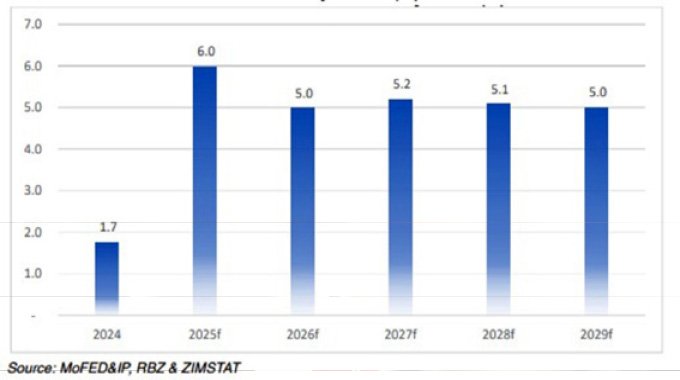
Business WriterZIMBABWE is forecasting a real Gross Domestic Product (GDP) growth of five percent for the period from 2026 to 2029, according to the 2026 Budget Strategy Paper signed off by Finance, Economic Development and Investment Promotion Minister Professor Mthuli Ncube.The Treasury chief has forecast the economy to grow by six percent this year, following a slowdown to less than two percent in 2024, due to the impact of the El Niño-induced drought.Economic growth this year is expected to be driven by a recovery in agriculture, increased mining activity and investments in infrastructure.In 2026, Zimbabwe’s economic growth is expected to be driven by sustained improvements in the agriculture, mining, information and communication technology, and electricity sectors, according to the strategy paper titled “Enhancing Drivers of Economic Growth and Transformation Towards Vision 2030”.The baseline assumptions for the 2026 growth forecast include “normal rainfall patterns”, a “stable macroeconomic environment”, enhanced electricity supply, continued improvements in the business environment, and a moderation in global commodity prices.However, officials acknowledge several downside risks, including “adverse weather conditions, which could substantially reduce agricultural output, with ripple effects on the wider economy.”Additionally, “persistent power supply constraints pose risks to industrial and mining productivity, potentially dampening growth prospects.”Volatility in global commodity prices and constrained access to external concessional financing may also adversely affect export earnings and fiscal stability, reads the strategy paper in part.In response, the Government states it will remain proactive and prepared to respond with appropriate instruments and policies to mitigate these risks.Inflation in 2026 is expected to be subdued, with year-on-year inflation forecasted to moderate to 12,7 percent by the end of year, averaging 17,1 percent over the fiscal year.This, according to the strategy paper, is underpinned by assumptions of “continued adherence to tight fiscal and monetary policies,” “no recourse to central bank financing of the deficit”, well-anchored inflation expectations and a “normal rainfall pattern”.Key risks to this inflation outlook include “supply-side shocks from ongoing geopolitical tensions”, which could lead to elevated imported inflation Authorities have stated they will ensure inflation and exchange rate stability through necessary policy instruments.The 2026 fiscal policy framework is designed to sustain fiscal discipline through a “targeted budget deficit of below three percent of GDP”.The projected budget deficit is based on total revenues of ZiG309.9 billion against planned expenditures of ZiG335.6 billion.In US dollars, this translates to projected fiscal revenue of $8,7 billion versus projected expenditure of US$9,4 billion, resulting in a fiscal deficit of US$722,2 million, or 1,4 percent of GDP.The Government will continue to align expenditure with available resources to support macroeconomic stability and sustainable growth.The Government’s revenue mobilisation strategy for 2026 is anchored on principles of equity, fairness, efficiency, and transparency, reads the strategy paper in part.The strategy will focus on enhancing tax administration, strengthening anti-smuggling efforts, and streamlining tax expenditures It also includes reforms to support increased tax compliance by micro-small and medium enterprises, as well as the informal sector, and explores mechanisms to align the tax contribution of key growth sectors to their share of GDP.For expenditures, the 2026 outlays will be guided by a commitment to advancing structural reforms Priorities will include agriculture and food security, infrastructure development, social protection, health sector investment, climate change adaptation and education and skills development
These outlays are intended to foster private sector-led economic growth and achieve the objectives of the National Development Strategy 2 (NDS2) and Vision 2030.Share on FacebookPost on XFollow usSave
Originally published on Zimbabwe Herald
Source: Zimbabwe Herald
All Zim News
All Zim News is a central hub for all things Zimbabwean, curating news from across the country so no story is missed. Alongside aggregation, our team of nationwide reporters provides real-time, on-the-ground coverage. Stay informed and connected — reach us at admin@allzimnews.com.
