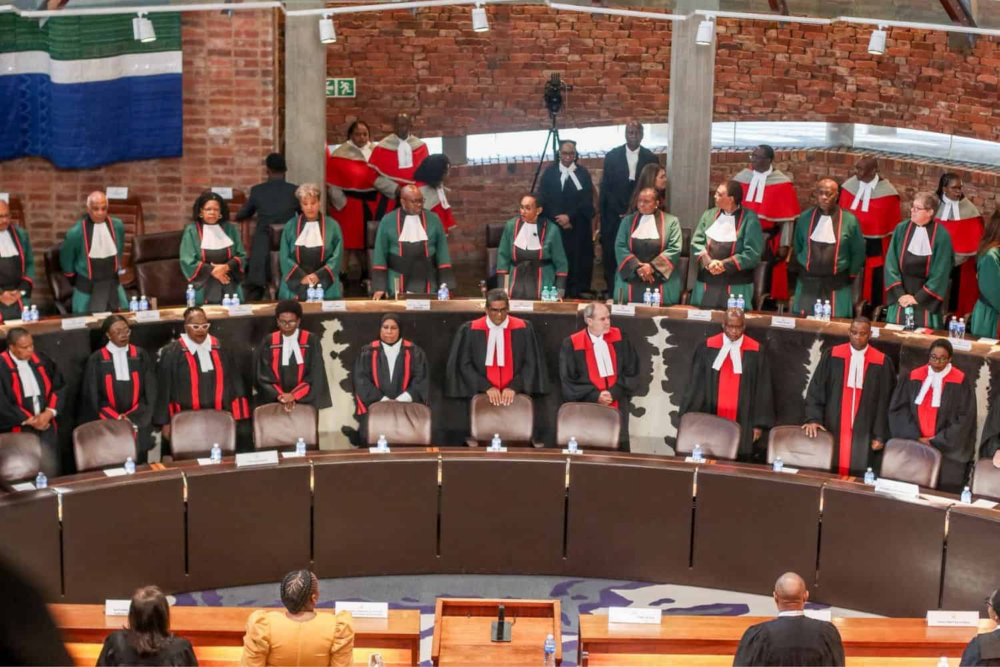
Thirty years ago, on 8 May 1996, South Africa chose an audacious path. In the wake of a brutal past defined by exclusion, dispossession and engineered inequality, the country did not simply replace one legal order with another. It reimagined the very purpose of law.
Three decades on, the Constitution stands as both a triumph and a test: a triumph of the human spirit and a test of whether we have the resolve to turn its promise into lived reality. At its core, South Africa’s Constitution is a transformative document that does not pretend that law is neutral in a society scarred by structural injustice. Instead, it demands that law be used consciously to redress the past and build a more equal future.
For this reason, it goes beyond civil and political rights to include socio-economic rights such as access to housing, healthcare, education and social security. It recognises a simple but profound truth: freedom that does not improve the material conditions of people is hollow and dignity cannot thrive amid deprivation. Thus, the Constitution serves as a blueprint for social change.
Read Full Article on Mail & Guardian
[paywall]
From its earliest days, the Constitution has been a contested document. For many, it represents a historic breakthrough and a foundation on which a just society can be built — a safeguard against the return of arbitrary power and a compass for transformation. For others, it is viewed with scepticism and frustration.
Critics argue that the Constitution has not delivered economic emancipation at the scale or speed required; that it reflects compromises that have constrained radical redistribution; and that it has, at times, been invoked to defend existing patterns of privilege. These tensions are real and cannot be dismissed. But neither should they lead to a simplistic conclusion that the Constitution is the obstacle to progress.
Crucially, it is also a living document. Its endurance lies in its capacity to evolve and be amended in response to new conditions and shifting societal needs. This adaptability is what keeps our democracy alive and relevant.
Each generation carries both the right and the responsibility to shape the Constitution so that it can respond to its realities while remaining anchored in its founding values. Over the past three decades, South Africa has seen compelling examples of the Constitution at work. Courts have upheld its principles in ways that have expanded access to essential services, protected vulnerable communities and reinforced the rule of law.
Civil society organisations have used it as a tool to advocate for justice, turning legal rights into tangible outcomes. These successes demonstrate that when institutions function and citizens are engaged, constitutional promises can be realised. At the same time, the gap between constitutional ideals and lived experience remains deeply concerning.
Inequality continues to define the social landscape. Millions still struggle with unemployment, inadequate housing and limited access to quality education and healthcare. Spatial divisions inherited from the past continue to shape opportunity and exclusion.
Service delivery failures and governance weaknesses undermine public trust. Corruption, though increasingly confronted, has eroded confidence in the ability of the state to act in the public interest.
[/paywall]
All Zim News – Bringing you the latest news and updates.
