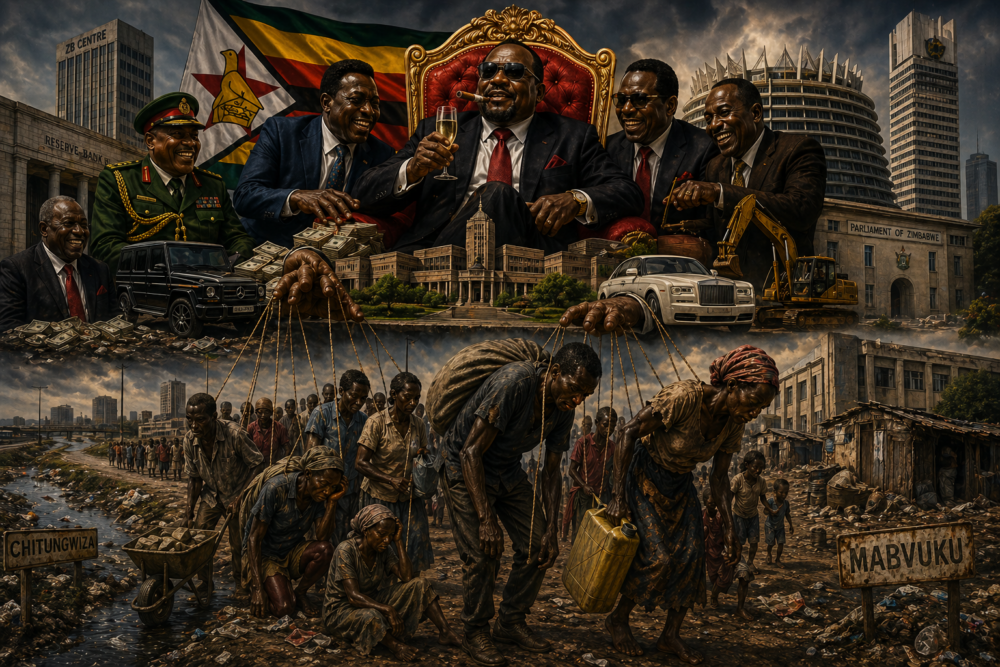
Emmerson Mnangagwa’s Zimbabwe is not merely a troubled polity; it is the quintessential laboratory of state capture in Africa. Here, oligarchs bankroll the regime, institutions are bent into instruments of protection and propaganda is weaponised to deflect blame onto sanctions, the opposition and so-called “unpatriotic” citizens. What masquerades as reform is in fact a carefully choreographed illusion, a phantom theatre designed to entrench corruption while projecting the mirage of renewal.
At the heart of this choreography stand three emblematic figures: Temba Mliswa, Wicknell Chivhayo and Kudakwashe Tagwirei, each embodying a distinct facet of ZANU-PF’s patronage machine. Mliswa, the loudmouth fixer, thrives on noise and intimidation, drowning accountability in factional theatrics. Chivhayo, the flamboyant youth patron, dazzles with ostentation, binding the next generation to the regime through spectacle rather than substance.
Tagwirei, the financial kingmaker, monopolises the commanding heights of the economy, fusing private empire with public power. Together, they form a triumvirate of capture, consolidating Mnangagwa’s hold on the state while hollowing out the promise of reform. Mliswa’s role epitomises the prebendal logic of Zimbabwean politics: he is not a policymaker in any meaningful sense but a political fixer whose utility lies in noise, intimidation and factional manipulation.
Read Full Article on Mail & Guardian
[paywall]
His interventions are carefully calibrated to protect oligarchs such as Chivhayo and Tagwirei, ensuring that ZANU-PF’s patronage machine remains intact. In the architecture of state capture, Mliswa functions as the enforcer of narrative chaos, the man who guarantees that corruption is never confronted as systemic rot but always reframed as factional intrigue. His loudmouth politics is not accidental; it is functional, serving the regime by drowning accountability in theatrics, shielding elites from scrutiny and consolidating Mnangagwa’s hold on power.
The cases that define his role illustrate this pattern with clarity. In parliament and public discourse, Mliswa substitutes substance with volume, a style so performative that even ZANU-PF ministers such as Tino Machakaire have dismissed his interventions as “noise over substance”. This deliberate cacophony is designed to obscure accountability rather than advance policy.
When the ZANU-PF Youth League criticised Chivhayo’s proposed US$3.6 million donation to parliament, Mliswa leapt to Chivhayo’s defence, castigating the league for “factional posturing” and reframing the controversy as an internal squabble rather than a serious question of corruption and undue influence. In succession politics, he has positioned himself as a gatekeeper, inserting himself into disputes between Mnangagwa and Chiwenga, ensuring that corruption dossiers are neutralised by being recast as factional battles. Taken together, these episodes reveal why Mliswa embodies the “loudmouth fixer”.
[/paywall]
All Zim News – Bringing you the latest news and updates.
