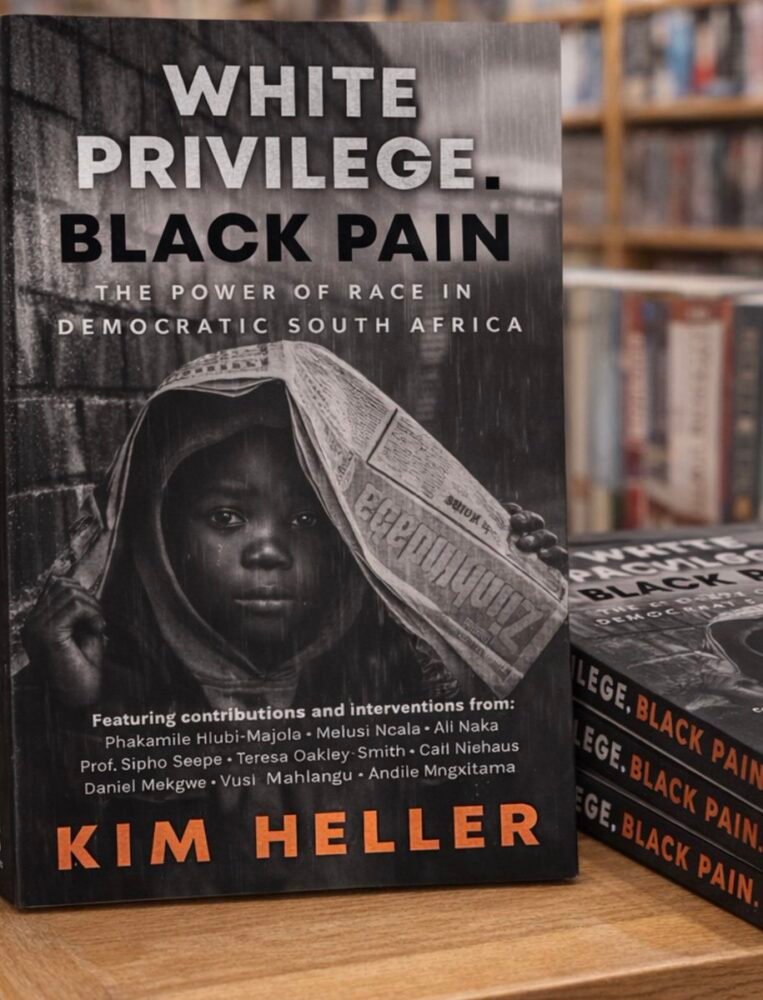
Andile Mngxitama wrote ofKim HellerinWhite Privilege, Black Pain: The Power of Race in Democratic South Africa: “Heller is upfront about her whiteness and the challenge it presents in writing about the black condition. But this very self-consciousness is part of the sophistication of how whiteness reproduces itself. The book does the job of exposing white power and its inherent unethical nature.
But her place as a white person is not diminished; instead, the unethical exercise of power by whiteness is affirmed.” He wrote those words as a contributor to the same volume. Teresa Oakley-Smith appears in it as well, carrying the corporatisation of nonracialism, where race gets reduced to workshop language, consultancy jargon and career opportunity for the morally ambitious. My grievance starts there because Mngxitama saw the mechanism clearly enough to name it, then walked into it and helped it along.
He seems to think that once he has named the problem, he has settled the matter and placed himself beyond critique. Revolutionary politics does not work that way. A man who claims the stature of a doyen in the tradition of Bantu Biko must answer to consistency.
Read Full Article on Mail & Guardian
[paywall]
I do not read that contradiction as a minor lapse. I read it as political instinct. Mngxitama has long moved towards spaces that offer recognition, safety and status once the demands of realpolitik enter the room.
For years, he shouted from the safety of a human rights NGO. He speaks against a formation and still seeks a place inside it. He condemns white confessional power and still helps it travel.
That instinct belongs to the present postmodern, post-truth age. It works in tandem with a politics that loves performance and strategic placement. It does not last on the hard ground of struggle.
Perhaps this explains the anxiety he displays around my presence. Years ago at the Lenasia housing protests, when bulldozers destroyed the homes of black Africans who had paid to build there and the conservative Indian community called for their removal, I watched that anxiety burst open when the police arrived. I saw him run like a frightened dog the moment he saw blue lights flashing.
That moment stripped the language of resistance away and left the body speaking for itself. Politics reaches that point sooner or later. A man either stands or he breaks.
Mngxitama still writes about his one night in jail as though it sits anywhere near what black Africans faced in the struggles before his arrival. I wonder how he would have fared at the age of 16 with a gang of white uniformed psychopaths letting Alsatian dogs loose on his genitals, or standing on a brick for four days with no sleep until your body collapsed inwardly? Or being mentally tortured through ongoing amplified noise as well as being told lies about family deaths while being locked alone in a cell for months at a time over a period of two years.
How would he have fared being imprisoned for seven full years between Robben Island and Pollsmoor? I speak here of my own experience. He does not carry that history — nor does he carry that discipline or the test.
In the 18 months that he dated my white production manager, which brought him into close proximity with Gillian (my wife) and me, I never saw in him the mettle that 1976 demanded. The state of that time required endurance under pain and a willingness to stand where fear had entered the flesh. His politics suit this postmodern age precisely because this age rewards pose, access and institutional reassurance.
It also ignores contradiction, the type that could have earned him a match and a tyre in the 1970s — because contradiction in struggle endangers the collective. Perhaps what has always unsettled him most about me is the fact that I did not climb onto the gravy train with some of my Robben Island cellmates and comrades. I stayed with the struggle.
I stayed with the people who still live under mines, police, poisoned land, racist labour relations and the long afterlife of white power. I did not barter prison memory for a platform. I did not turn struggle into social currency.
I certainly did not build a self out of revolutionary residue. I remain rooted in the ground where politics still exacts a price. That word came loaded with intent.
He wanted to castrate me in the eyes of others. I saw his desire to shrink a black man whose life in struggle exposed the weakness of his own political formation. I read that move as a reflection of white masculinity and the psychic damage colonial life leaves behind.
Fanon understood inward damage. Colonial society pushes the black man to seek shape, value and recognition in a white direction. That movement becomes black comprador politics when it throws contempt downward at a black man forged in struggle while extending legitimacy upward to a book organised around white confession. Mngxitama chose proximity to that formation.
[/paywall]
All Zim News – Bringing you the latest news and updates.
