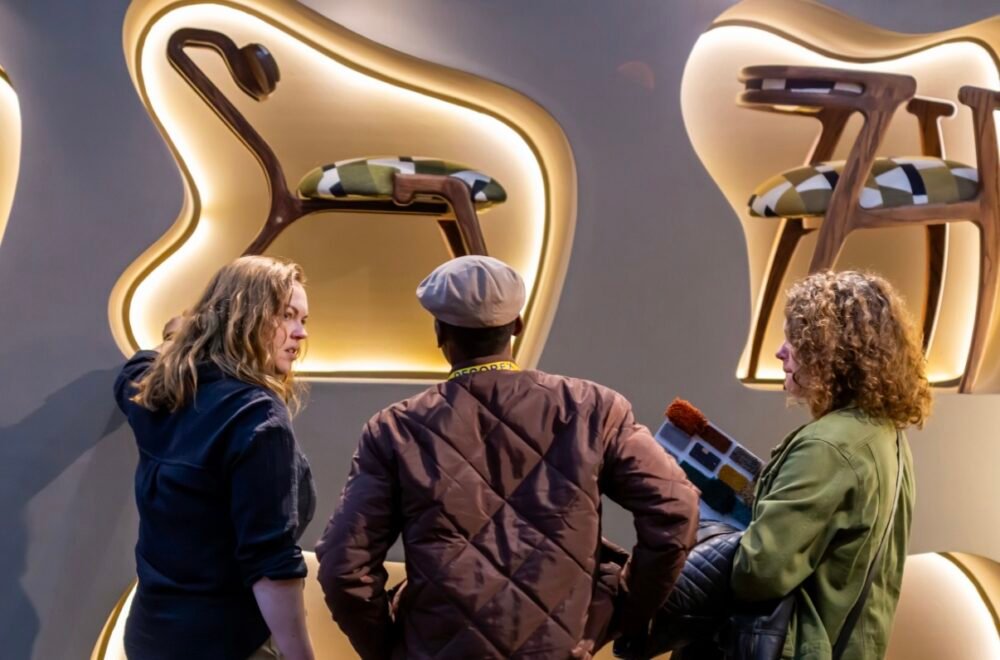
Soft life, in the South African context, has never been a singular thing. It slips between meanings, refusing to settle. For some, it is an aesthetic of ease, plush interiors, diffused lighting and linen curtains breathing with the wind.
For others, it is something far more political: a quiet rebellion against exhaustion, against the inherited urgency of survival. A good life, yes. But also a better one.
A softer landing in a country that has historically offered very few. I often return to the work of Blessing Ngobeni, particularly hisMirror Soft Lifeseries consisting of paintings and collectible furniture that collapse the boundary between object and memory. In these works, textiles carry weight.
Read Full Article on Mail & Guardian
[paywall]
They remember. They stretch across time, holding the residue of historical violence in their fibres, asking what it means to live comfortably in a place where comfort was once systematically denied. In Ngobeni’s world, soft life is not indulgence.
It is inheritance, negotiation and sometimes contradiction. When Decorex Africa announced “Soft Life” as its 2026 theme, it felt less like a trend forecast and more like a cultural checkpoint, a moment to ask, with intention: What does softness look like here, now? In conversation with Garreth van Niekerk and Alan Hayward, co-founders of Always Welcome and executive creative directors of the fair, it becomes clear that their approach resists definition.
Instead, they are interested in multiplicity. “What we were really trying to do when we landed on ‘Soft Life’ as a theme was find something that could resonate across different African contexts, something that didn’t feel imported or imposed,” they explain. “We were drawn to the fact that the idea itself originated on the continent, from Nigeria, from a digital culture already questioning hustle culture and intensity.
“But more than that, we were interested in how that idea has evolved, how it has fractured into different meanings depending on who is using it and where they are using it. For us, it became a way of asking how those same principles of rest, ease and intentionality could be translated into design, into the spaces we inhabit every day,” Hayward says. The translation, they insist, is both practical and emotional.
[/paywall]
All Zim News – Bringing you the latest news and updates.
