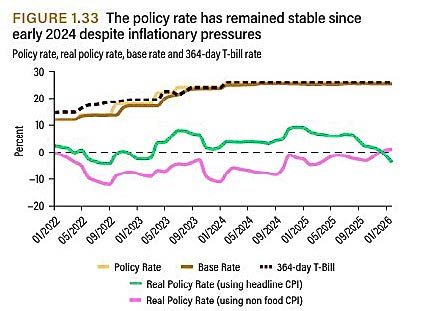
The Economics Association of Malawi (Ecama) says the 200 basis point cut in the policy rate by the Reserve Bank of Malawi (RBM) reflects early signs that inflationary pressures could be easing. But the economic think-tank has warned that the impact on borrowing costs could be limited if fiscal deficits and foreign exchange shortages persist. On the other hand, Malawi Confederation of Chambers of Commerce and Industry (MCCCI) thinks the policy rate cut will have limited impact on businesses unless cost pressures for improving the competitiveness are addressed.
The reaction from Ecama and MCCCI follow the decision of the Monetary Policy Committee (MPC) to trim the policy rate from 26 percent to 24 percent, a move aimed at easing tight monetary policy conditions after a prolonged period of high inflation and elevated interest rates. In an interview on Saturday, Ecama president Bertha Bangara-Chikadza said the policy shift reflects the central bank’s attempt to balance price stability with the economic activity. “The decision reflects early signs of easing inflationary pressures to allow limited support for growth and investment without jeopardising price stability,” she said.
Bangara-Chikadza, who teaches economics at University of Malawi (Unima) said the tightening cycle adopted in recent years was largely a response to persistently high inflation, fiscal deficits financed through domestic borrowing and chronic foreign exchange shortages. However, she cautioned that monetary policy is likely to remain restrictive in real terms because inflation remains elevated and non-food prices have begun rising. In a statement on Saturday, MCCCI said the rate cut will have limited impact on businesses unless cost pressures for improving competitiveness are addressed.
[paywall]
The private sector lobby group said apart from borrowing costs, foreign exchange shortages and inflation continue to constrain private sector growth, adding that many firms are still struggling with limited access to foreign currency, which has disrupted production cycles and raised operating cost. Reads the commentary in part: “The elevated inflation is largely driven by rising non-food inflation, particularly increases in fuel and electricity prices, which have significantly raised production and transportation costs for businesses.” In a separate interview, Unima economics lecturer Edward Leman said the rate cut comes at a time inflation dynamics remain mixed. He noted that the recent decline in overall inflation has largely been driven by easing food prices while non-food inflation has remained relatively persistent. “Extremely high policy rates do not necessarily contain inflation effectively and in some cases, may even contribute to its persistence by raising the cost of capital across the economy,” said Leman.
[/paywall]
All Zim News – Bringing you the latest news and updates.
