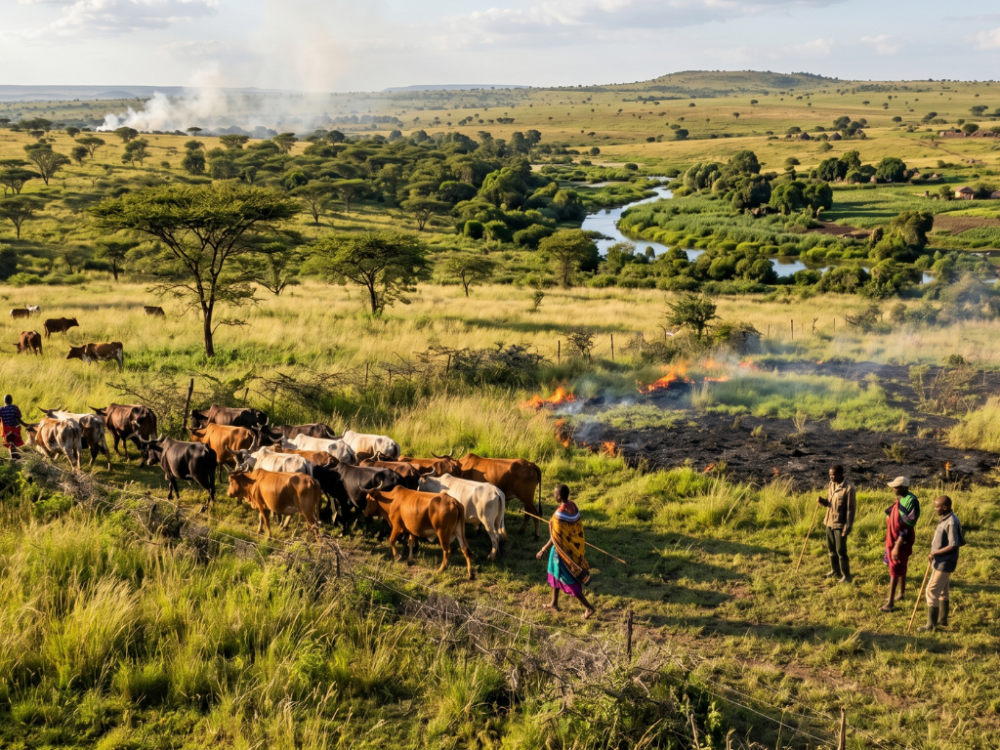
Better livestock and fire management across Africa’s savannas,grasslandsand shrublands could unlock one of the continent’s most significant climate opportunities — one that sits inside the daily realities of how people move livestock, use fire and depend on land for survival. The landscapes cover nearly 70% of sub-Saharan Africa and are often mischaracterised in global climate debates as degraded or marginal. The roadmap underlying the analysis argues the opposite: they are working ecosystems, shaped over centuries by grazing, fire and rainfall and central to both biodiversity and rural economies.
If managed differently, they could also become a major climate sink.Africa’s Nature Transition: A Roadmap for People, Nature and Climateestimates that improvedrangeland management, particularly through rotational grazing and prescribed burning, could store up to 11 gigatons of carbon dioxide equivalent by 2050. That is roughly a fifth of current annual global emissions, achieved not through new technologies but through changes in how landscapes areused and restored. The scale of the potential sits within a broader shift in thinking running through the report, which was produced byConservation Internationaland theFuture Ecosystems for Africa(Fefa) programme at Wits University.
Africa contributes only about 4% of global emissions, yet experiences some of the most severe climate impacts, from recurring droughts and floods to accelerating land degradation. Against that imbalance, the roadmap estimates that a coordinated set of ecosystem-based interventions across sub-Saharan Africa could deliver up to 1.6 gigatons of carbon mitigation annually between 2026 and 2050, while strengthening food systems, biodiversity and water security. “For too long, global climate policy and finance have treated Africa as an afterthought.
Read Full Article on Mail & Guardian
[paywall]
This roadmap seeks to change that,” says Conservation International’s chief field officer in Africa,Jimmiel Mandima. “It’s an African-led initiative that says economic growth doesn’t have to come at a high carbon cost. We can drive climate action while also advancing economic growth aspirations and lifting people out of poverty.” The report is equally explicit that the outcomes depend on how people are included in the process.
As the foreword by researchers at Wits’ Fefa programme stresses, climate solutions in Africa cannot be separated from the realities of how people live with and manage nature. “Many people in Africa today live within and alongside nature,” write professorLaura Pereira, the co-principal investigator of the Fefa programme and professorSally Archibald, who leads theFefa programme.
[/paywall]
All Zim News – Bringing you the latest news and updates.
