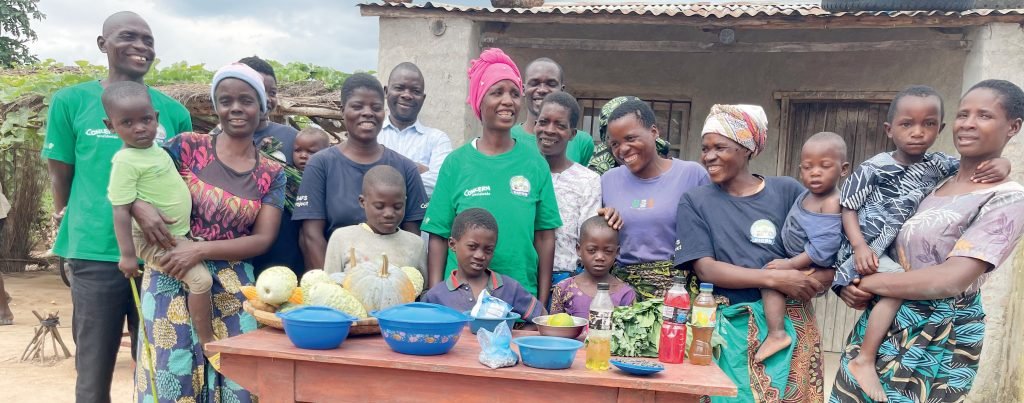
Fyness Chakana still remembers the paralysing fear she felt a decade ago when she nearly lost her child to malnutrition. It is a memory that does not fade; instead, it fuels her mission. Today, Chakana is a woman on a mission, vowing that no other child in her village will face the same fate.
“I nearly lost my child,” recalls Chakana, from Kavala Village in Traditional Authority (TA) Dambe, Mchinji. Her voice is steady with resolve: “Since then, I decided to spend my life ensuring other mothers have the knowledge and support I lacked.” However, her work—and that of her fellow volunteers—is more critical than ever as Malawi grapples with a persistent food insecurity crisis. The Africa Agenda 2063 calls on nations to deliver inclusive development by radically transforming agriculture to enable the continent to feed itself.
Locally, the Malawi 2063 blueprint echoes this, prioritising the health of women and adolescents to halt intergenerational stunting. Despite these high-level visions, malnutrition remains a significant hurdle. According to the 2024 Demographic and Health Survey, 38 percent of children under-five in Malawi suffer from stunting, a condition of chronic malnutrition that permanently impairs physical growth and cognitive development.
[paywall]
Ironically, Mchinji District—located 111 kilometres west of Lilongwe city—is hailed as the “breadbasket” of central Malawi. Yet, Mchinji currently faces a stunting rate of 44 percent, significantly higher than the national average. In many households, nutritious produce is reportedly sold to meet immediate financial needs, leaving families with little more than plain maize porridge.
This “sell-all” culture, combined with climate shocks like El Niño, has created a food insecurity crisis in the midst of plenty. In 2021, Chakana and her fellow community members formed the Chimwemwe Care Group in Kavala Village to combat these statistics. However, passion alone wasn’t enough; the group nearly collapsed under the weight of limited technical knowledge and a lack of resources.
“Cicod supported us to revive the group when it was on the brink of collapsing,” Chakana explains. “They provided yellow maize seeds, high-nutritive indigenous seeds, and more importantly, the technical training that actually saves lives.” Chakana says the activities centre on the “Malawian 6 Food Groups.” “On the 20th of every month, caregivers gather to learn how to incorporate staples, legumes, vegetables, fruits, animal-source foods, and fats into every meal through homestead gardens and cooking demonstrations,” she explains.
[/paywall]
All Zim News – Bringing you the latest news and updates.
