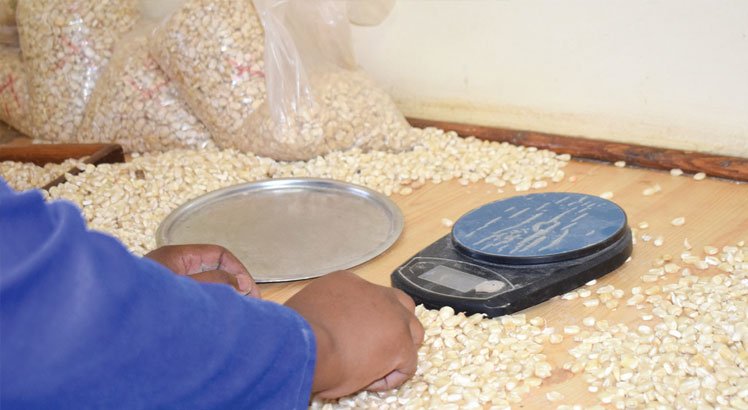
Emily Sanjira and her family have been struggling with hunger as hybrid maize varieties keep failing under harsh weather in the drought-prone district of Balaka. “The adopted varieties could not withstand prolonged dry spells. Unlike the local varieties we used to grow, the new ones yielded too little and proved vulnerable to climate shocks,” she says.
Sanjira’s crop yields dropped drastically from 57 bags to just five when she switched from local seeds to hybrid seeds. To feed her family for three weeks, she required 15 kilogramme of flour from local maize compared to 35kg from hybrid varieties. With widespread use of hybrid varieties recommended by agricultural extension officers, it became difficult for her and other farmers to find local maize seeds.
However, since the 2020/21 growing season, the farmer’s fortunes have shifted as a result of growing local maize varieties that survive prolonged dry spells. Umodzi Farmers Club lead farmer Clement Bonongwe says local varieties assure growers of food security because they yield more and last longer. He gets 54 bags of maize from a one-acre field where hybrids used to give only six bags.
[paywall]
About 700 female-headed and 800 male-headed households enjoy this feat courtesy of the Farmer-Saved Seed Market Project run by Practical Action Malawi. The initiative supports farmers in identifying and restoring resilient local varieties. The 1500 families have also been equipped with climate-smart agriculture practices such as pit planting, manure use, water harvesting and agroforestry.
The project has also reduced production costs. Unlike hybrid seed, for which a five kg packet costs K60 000 to K80 000, local seeds are free and can be saved, shared and replanted. “It was costly to replant the hybrids as I had to buy seed twice in a season.
I save about K120 000 because I recycle my local seeds,” says Sanjira, adding that she sells surplus harvests. In Chikwawa, another semi-arid district, Agnes Mpando says local seeds have transformed her family’s livelihood.
[/paywall]
All Zim News – Bringing you the latest news and updates.
