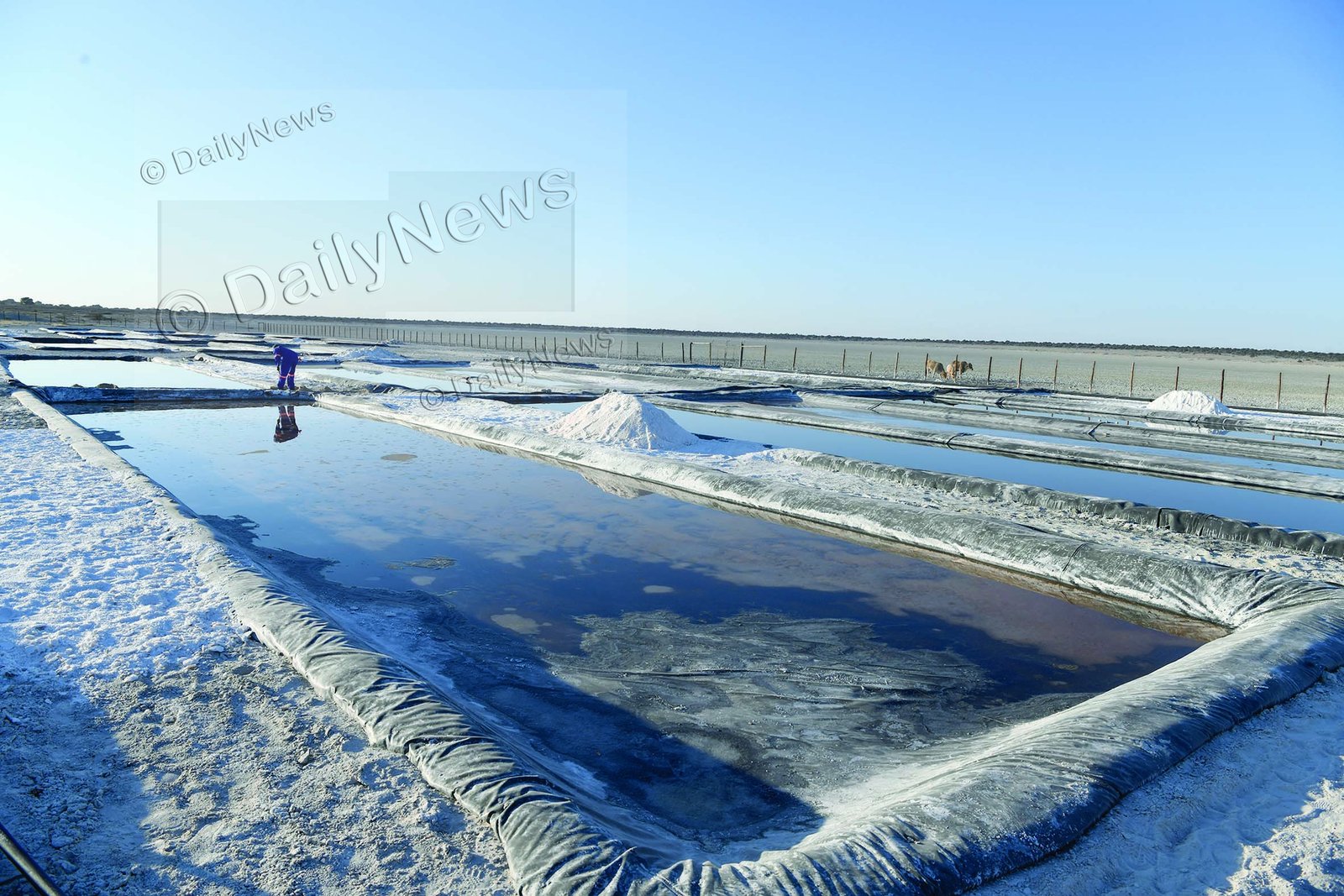
For generations, the vast salt resources of Zutshwa have lain largely untapped, sustaining livelihoods on a modest scale but never quite unlocking their full potential. Now, residents of the village believe that moment has finally arrived. The Zutshwa community has unanimously endorsed a proposal for the Qhaa-Qhing Conservation Trust to partner with a private company in the production of salt and soda ash, a move widely viewed as a turning point for both the village and the wider Hukuntsi sub-district.
At the heart of the proposal is the expansion of operations at the Zutshwa Salt Mine, a community-based project run by the Qhaa-Qhing Conservation Trust. Established in 1989 through the Rural Industrial Innovation Centre with support from the Cooperation for Research Development and Education, the mine has also benefited over the years from the Poverty Eradication Programme through the Rural Development Council. Despite producing 99.9 percent high-quality salt, the mine has struggled to operate at full capacity due to persistent financial constraints.
These challenges have resulted in lost sales and revenue, as production has consistently fallen short of market demand. It is against this background that the trust has remained open to strategic partnerships, a stance that has now attracted interest from Zimbabwe-based Berhard Development Corporation, through its subsidiary, 9th Hour Projects. Addressing residents at a kgotla meeting attended by key stakeholders, including the Embassy of Botswana in Zimbabwe, Botswana Investment and Trade Centre, Hukuntsi District Council and the District Commissioner’s Office, 9th Hour Projects Executive Officer, Mr Bernard Mutanga, outlined an ambitious proposal to develop a soda ash project alongside salt production.
Read Full Article on Daily News Botswana
[paywall]
Mr Mutanga said the project would tap into Zutshwa’s abundant trona deposits to produce salt and high-quality soda ash for the global market. He revealed that the company had already secured about 1 900 hectares of land in Tshesebe, where it plans to manufacture steel using by-products from salt production. He further disclosed that Berhard Development Corporation intended to establish steel manufacturing, iron processing and lithium plants in Botswana, adding that Zutshwa’s reputation for high-quality salt was a key factor in attracting the company’s interest.
The proposed partnership, he explained, sought to leverage Botswana’s position as the world’s second-largest producer of soda ash, a resource that would also feed into lithium product manufacturing. If implemented, the project is expected to create between 15,000 and 20,000 jobs nationally, with Zutshwa alone set to benefit from about 300 direct jobs and 450 indirect jobs. Annual output is projected at 200,000 tonnes of soda ash and 800,000 tonnes of salt.
[/paywall]
