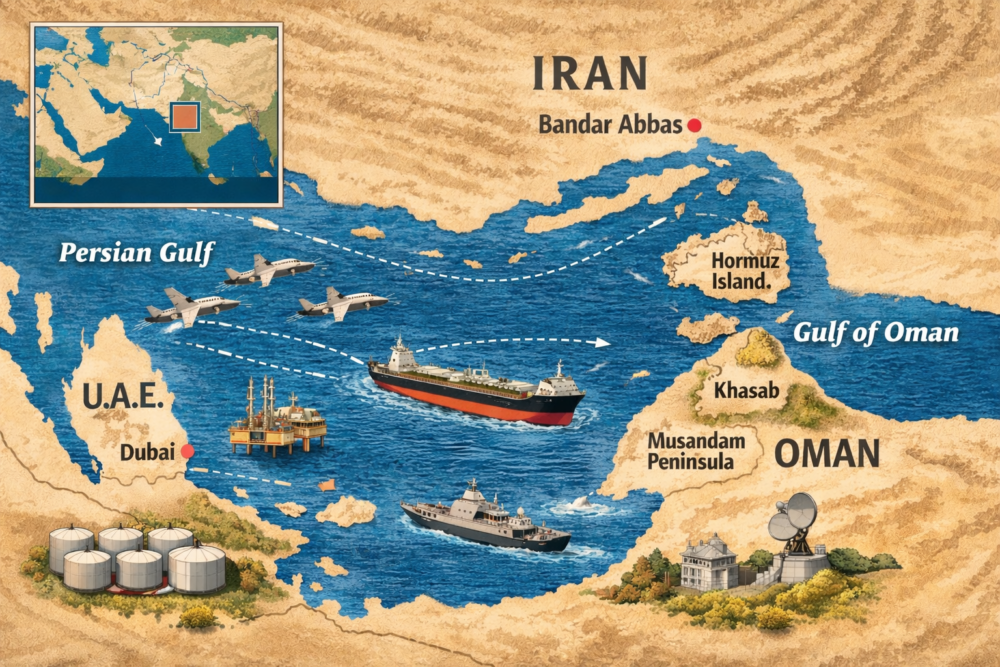
The 28 February 2026 pre-emptive strike jointly by the United States of America and Israel on Iran and the subsequent counterattacks on Gulf States, rendered the Strait of Hormuz, the vital global maritime energy trade route, vulnerable. Economists are warning of a global recession should the Strait remain closed for more than a month, a likely scenario at the current trajectory. Less than forty kilometres wide at its narrowest point, the Strait of Hormuz carries roughly one-fifth of the world’s oil and about a fifth of the global liquefied natural gas LNG trade.
In the first week of the conflict, maritime traffic through the routeplunged by almost 70%,rendering dozens of loaded tankers stranded inside the Persian Gulf.Crude oilprices have surged, with Brent crude touching $114 per barrel on 9 March 2026, the highest level since 2022. Analysts have warned that prolonged disruption could push prices well beyond $120, with some forecasts indicating up to $150 per barrel. This is not merely an energy crisis.
It is a systemic shock to the chemical and industrial backbone of the global economy, one that is already triggering legal force majeure declarations, production halts and supply chain emergencies across multiple continents. On the morning of March 4, 2026,Qatar Energyannounced a “force majeure.” Citing “escalating armed conflict in the Middle East”, declaring it could no longer honour contracts for (LNG) – roughly one-fifth of global supply. At the time of the announcement, the Strait of Hormuz was not yet physically blockaded but commerce had already halted.
Read Full Article on Mail & Guardian
[paywall]
Within hours,Aluminium Bahrain, the world’s largest smelter outside China, issued a similar notice, followed shortly by the Qatari aluminium smelter,Qatalum, which shut down entirely. The Norwegian co-owner, Hydro, has warned that resumption of production at the plant could take six to 12 months. The Gulf is not simply an energy hub; it is one of the central chemical and industrial engines of the global economy that is now seizing.
When Qatar Energy invoked force majeure, it triggered a legal domino effect across supply chains. TheAsian petrochemicalsector followed suit, as Singapore’s PCS, Indonesia’s Chandra Asri, and South Korea’s Yeochun NCC issued similar declarations. Wheninsurersdesignated the Gulf a “war-risk zone,” premiums surged from 0.05% to 1% of hull value, meaning a $500,000 premium for a $50 million vessel, up from $25,000.
Some insurers now demand up to $5 million for tankers carrying Iranian oil. While most economists and news reports focus on the oil price surge and the consequential rise in cost of living, few recognise the broader impact on other sectors of the economy. The Gulf supplies the chemical foundation of modern agriculture: ammonia and urea for fertilisers, sulphur for phosphate processing and the petrochemical feedstocks for pesticides and herbicides.
South Africa’s agricultural sector has already absorbed significant input cost inflation because of an increase in domesticfertiliser pricesfrom 2021 to 2025. These increases were driven by a combination of elevated international prices and rand depreciation against the dollar, amplifying import costs for raw materials. While oil shocks move markets in hours, agricultural shocks move harvests in seasons.
For import-dependent regions, food insecurity is expected within months, not years. Few sectors reveal the invisible reach of Gulf petrochemicals more clearly than healthcare. The pharmaceutical industry depends on petrochemical-derived feedstocks for Active Pharmaceutical Ingredients, solvents and speciality intermediaries.
Packaging materials, plastic resins, polymers, glass and aluminium, face immediate constraints but the most critical vulnerability lies in the helium extracted from natural gas processing as an essential gas for cooling superconducting magnets in MRI scanners, spectrometers, cryostats, and imaging devices. Qatar suppliesroughly 30%of global helium, hosting one of only two plants in the world that produce semiconductor-grade helium. A disruption in helium supply would force hospitals to postpone diagnostic procedures, delay cancer treatments, and cancel neurological assessments.
The gas is also irreplaceable in semiconductor fabrication, where it maintains ultra-clean environments for chip production, vital to data centres and technology, and in aerospace, where it pressurises rocket fuel tanks. The constraint is not unique to advanced diagnostics. India, which supplies a substantial portion of South Africa’s generic medicines, faces rising freight costs forActive Pharmaceutical Ingredientimports from China and shipping line surcharges of 25% for Gulf routes, or outright cargo refusals.
The drugs may be available in Indian warehouses but would be difficult to reach port at a viable cost. For a country dependent on consistent supplies of antiretrovirals, antimalarials, and insulin, this represents a public health risk layered atop economic disruption. Beyond food and health, the Gulf supplies the physical fabric of daily life.
Synthetic fibres constitute64% of global textileproduction, with polyester alone accounting for 54% of the market. These fibres are manufactured from petroleum-derived chemicals through polymerisation processes. Apart from clothing and textiles, the furniture industry faces immediate pressure.
Upholstery foams, synthetic fabrics, varnishes and adhesives all derive from petrochemical feedstocks. A South African furniture manufacturer relying on imported polyurethane foam, derived from Gulf petrochemical complexes, faces either supply interruption or 40-60% price increases as alternative suppliers in Europe and Asia face identical shortages. Construction materials face parallel constraints.
Epoxy resins are essential for construction coatings, adhesives and wind turbine blades. Soda ash, used in glass manufacturing and solar panel production, represents another vulnerability. Titanium dioxide, the pigment that makes paint white and sunscreen protective, relies on sulphate and chloride processes tied to petrochemical supply chains.
Aluminium production, concentrated in Gulf smelters powered by natural gas, accounts for roughly10% of global refined supply. The metal is foundational to power transmission cables, renewable energy equipment and packaging. The force majeure declarations from Qatalum and Aluminium Bahrain signal constraints that will propagate into electrical infrastructure and consumer goods packaging within months.
[/paywall]
All Zim News – Bringing you the latest news and updates.
