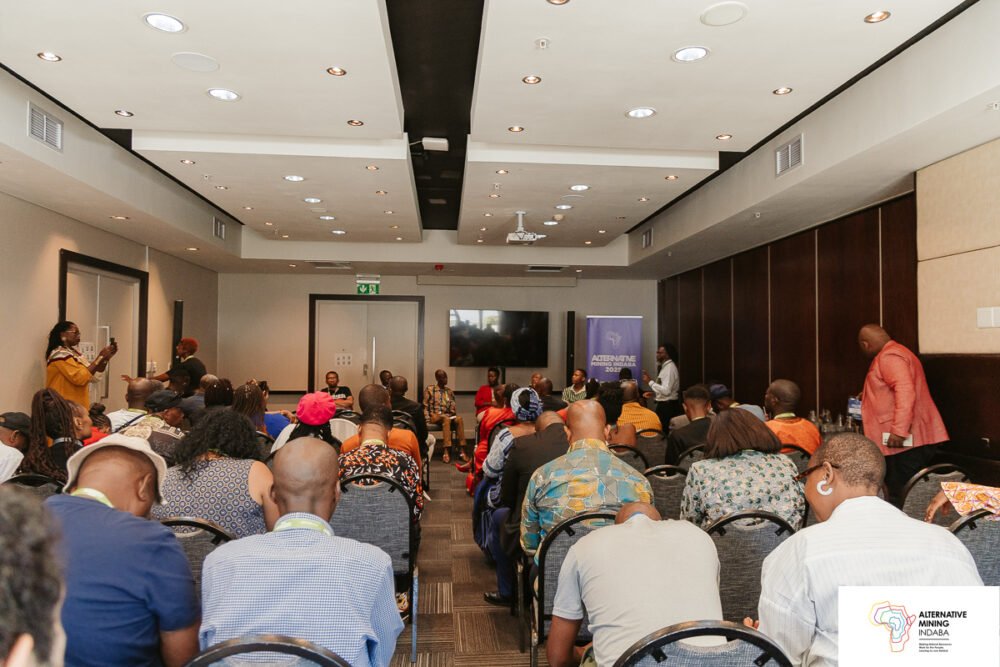
The Alternative Mining Indaba (AMI) has never been comfortable with power. Since its inception, it has positioned itself as a counter-space – a forum where mining-affected communities, activists, and faith-based movements confront extractive capitalism rather than negotiate its terms. That is why one moment at AMI 2026 was quietly significant: for the first time in the Indaba’s history, the United Nations entered a people-led political space.
The United Nations High Commissioner for Refugees (UNHCR) and the United Nations Development Programme (UNDP) joined in conversation with nearly 100 stakeholders, comprising community representatives, civil society organisations, faith-based actors, researchers, activists, academics, trade union representatives, and advocates from across Africa, Ukraine, and Indonesia, for a fireside chat convened by theEconomic Justice Network(EJN–FOCCISA), in strategic partnership with the Open Society Foundations (OSF). The event was held on 12 February at the Pullman Hotel in Cape Town as one of several side events that complemented AMI 2026. Its title –Building People’s Power to Confront Extractive Power– was not symbolic.
It shaped the politics of the room. Running from 9–11 February in Cape Town, South Africa, under the theme“Alternative Stories of Mining – United in Solidarity with Mining-Affected Communities across the Continent,”this year’s gathering reaffirmed AMI’s longstanding role as a counterweight to extractivism and a champion of people-centred resource governance. AMI 2026 unfolded amid intensifying global competition for so-called “future minerals”, securitised supply chains, and renewed attempts to rebrand extraction through the language of green transitions and digital economies.
Read Full Article on Mail & Guardian
[paywall]
Across panels, the message was consistent: extractivism is not a technical policy problem. It is a political system rooted in colonial histories, corporate power, and global inequality. The EJN–OSF fireside chat reflected this orientation.
Moving away from elite panel formats, the session prioritised political education, lived testimony, and collective strategising. Faith leaders, economists, lawyers, community organisers, and regional advocates from Africa, Latin America, Asia, and Eastern Europe interrogated not only extractive harm, but also the limits of resistance itself. What has worked?
What has failed? And why has corporate power proven so adaptable, even as the harms remain unchanged? Early discussions challenged romanticised narratives of struggle and subjected the “just energy transition” to critical scrutiny.
Justice for whom, and at whose cost? Participants spoke of land dispossession, water depletion, pollution, forced resettlement, gendered labour burdens, impacts on community health, and the quiet transfer of environmental and economic debt to future generations – all justified in the name of development. Subsequent panels examined power dynamics between African states, multinational corporations, and global actors.
Beneficiation deals, reciprocal trade arrangements, and critical minerals partnerships were unpacked as forms of extractive diplomacy that frequently entrench dependency rather than dismantle it. From the Democratic Republic of Congo to Indonesia, Ukraine to Southern Africa, communities are increasingly treated as sacrifice zones in the global race for lithium, cobalt, and rare earths. What distinguished these conversations was their refusal to remain abstract.
Geopolitics was translated into organising language. Trade agreements were discussed in terms of everyday survival. Extractivism was named not only as an economic model, but as a democratic failure.
It was within this politically grounded context that representatives from the United Nations High Commissioner for Refugees (UNHCR) and the United Nations Development Programme (UNDP) entered the conversation – a first for the Alternative Mining Indaba. Moderated by Zimkhitha Khweza, the session focused on human rights, economic inclusion, and livelihoods in extractive contexts. Addressing a question that hung palpably in the room –what is UNHCR (quite simply, the UN) doing here?– Kavita Belani, UNHCR’s Country Representative in South Africa, was direct.
“If we only worked where it felt safe and familiar,” she said, “then I would not be fulfilling the mandate of UNHCR.” Belani located UNHCR’s presence within a global crisis that is no longer peripheral to development debates. With more than 117 million people displaced worldwide – more than half of them in Africa and Asia – displacement now shapes labour markets, community cohesion, regulatory expectations, and long-term operational risk.“Displacement, social stability, and economic activity are intersecting whether we acknowledge it or not,”she noted.
[/paywall]
All Zim News – Bringing you the latest news and updates.
