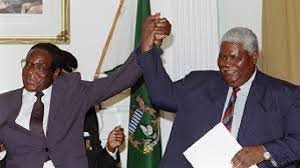
Thirty-eight years after the signing of the 1987 Unity Accord, the deeper aspirations of reconciliation, inclusion and national cohesion it promised remain largely unfulfilled, with Zimbabwe still fractured along enduring fault lines of tribalism, nepotism, cronyism and regionalism. December 22 is officially commemorated as Unity Day, marking the agreement between the late Vice President Dr Joshua Nkomo’s PF ZAPU and the ruling Zanu PF, a pact that ended the violent Gukurahundi conflict in Matabeleland and parts of Midlands in the early years of independence. While the accord succeeded in ending the violence, critics argue that it failed to translate peace at leadership level into lived unity for ordinary citizens.
National Chairman of a faction of the Zimbabwe National Liberation War Veterans Association, Ethan Mathibela, said the day should be a moment of honest reflection rather than ceremonial celebration. “December 22 is a commemoration of the Unity Accord of 1987, a pivotal moment in the history of Zimbabwe, which calls upon us not only to remember an agreement signed on paper, but to reflect on its meaning, its achievements, and the work that remains unfinished,” Mathibela said. “At its core, the Unity Accord affirmed a fundamental truth: that the strength of Zimbabwe lies in the unity of all its citizens.
Unity is not uniformity, nor is it silence about history. It is the conscious decision to coexist, to respect one another’s dignity, and to pursue national progress together despite past divisions.” Mathibela acknowledged that one of the accord’s most significant achievements was the cessation of open hostilities. “One of the most significant outcomes of the Unity Accord was the cessation of physical hostilities in the Matabeleland and Midlands regions.
[paywall]
The silencing of the guns brought relief to communities that had endured fear, displacement, and loss,” he said, adding that the agreement remains “an important milestone in preserving national cohesion.” However, he said peace alone did not amount to justice or equality. “Honesty compels us to acknowledge that while the Unity Accord achieved peace, some of its deeper aspirations are yet to be fully realised,” Mathibela said. He argued the accord was largely implemented at elite political level, with former PF ZAPU leaders absorbed into government, while their broader constituencies remained excluded.
“The Accord was implemented primarily at leadership level. Yet the broader constituencies they represented, including former PF ZAPU cadres and ZPRA combatants, did not always experience meaningful inclusion in governance, decision-making, or national development in the spirit envisaged by unity and reconciliation,” he said.
[/paywall]
