Few industries carry the weight of expectation that mining does in Africa. Yet, the sector also carries a legacy of risk. According to the Minerals Council South Africa, the country’s mining industry has reduced fatalities by91% since 1994, from 484 deaths to a record low of 42 in 2024.
However, as the Council reminds us, 42 is still 42 too many. The question is no longer whether Artificial Intelligence (AI) can help close that gap, but how responsibly and how quickly it can do so. This question was at the heart of theMining Indaba 2026panel discussion, “AI in Mining – Separating the Hype from Reality”, where miners and technology innovators explored how partnerships are turning AI’s potential into meaningful operational impact.
ForSiemens, the answer begins with a clear-eyed view of what AI can and cannot do, and a commitment to deploying it where it matters most: keeping people safe. The hype around AI in mining is real, but so are the results. One of the most established use cases is predictive maintenance.
Read Full Article on Mail & Guardian
[paywall]
According toMcKinseyfindings, AI-driven predictive maintenance can reduce equipment downtime by up to 50% and lower maintenance costs by 10% to 40%. In practical terms, this means fewer reactive interventions, less worker exposure to hazardous equipment, and operations that run more reliably. For a sector where theUN Environment Programmeestimates Africa holds approximately 30% of the world’s mineral reserves, reliable operations are not just a commercial concern; they are an economic imperative.
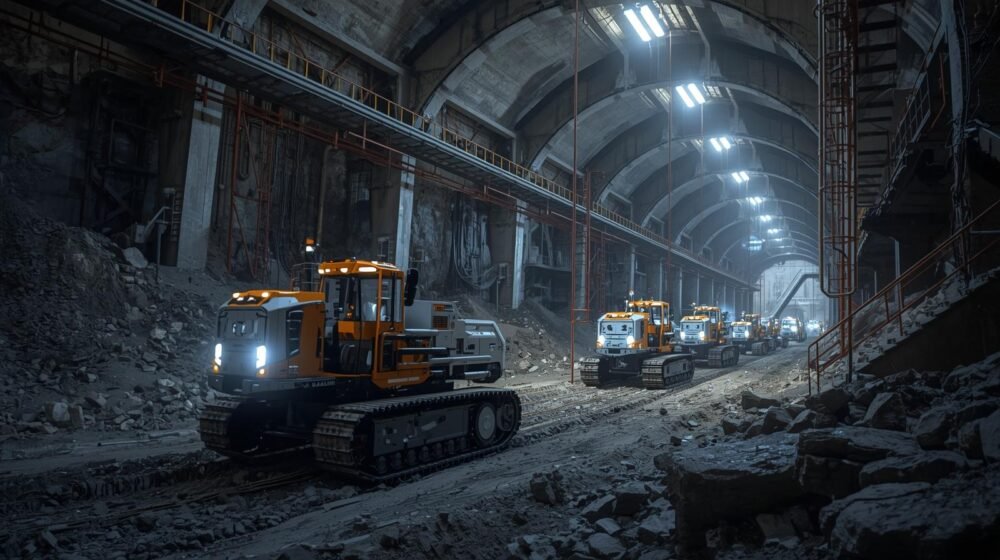
Siemens’2040 View of South Africaresearch paints a compelling picture of where the industry is heading. Autonomous haul trucks, self-driving drillers, drones and robots will increasingly take over in harsher environments, making working conditions safer for human miners. The research further indicates that 30% to 40% of mining machinery could be autonomous by 2040.
Visualisation tools based on AI, augmented reality, and virtual reality will help miners locate minerals and develop better operational strategies, while wearable technologies will guide workers with real-time information. Up to 40% of mines will use digital twins to simulate processes, detect danger and determine the next best actions, especially in rough terrain. As physical human labour is progressively phased out by robotic systems, the reskilling of today’s workforce becomes a clear investment priority in the mission to achieve a safe Just Transition.
Humans, in turn, will do more meaningful, skilled and creative work – shifting from manual operation to systems oversight, data analysis and remote operations management. However, even the most advanced AI is only half the solution. The real power of AI in mining lies not just in the technology but in the partnerships that bring it to life.
AI does not scale through point solutions. It requires integrated systems, governed data, long-term commitment and, critically, collaboration between miners and technology innovators. For Siemens, this means operating as a technology partner to mining companies – integrating electrification, automation and digitalisation so that AI supports safer, lower-carbon and more resilient operations without adding complexity.
In a sector where Africa supplies a dominant share of materials critical to the global energy transition, the stakes extend well beyond individual mine sites. The road ahead is challenging, but the direction is unmistakable. Africa’s mining sector will continue to evolve, and what differentiates the next phase is the speed and scale at which AI and workforce transformation are converging.
Africa must seize every opportunity for innovation to make this vision a reality. Mining is the backbone of many of the continent’s economies, and it is vital to the livelihoods of millions. Sabine Dall’Omo is the CEO of Siemens Sub-Saharan Africa
[/paywall]
All Zim News – Bringing you the latest news and updates.
