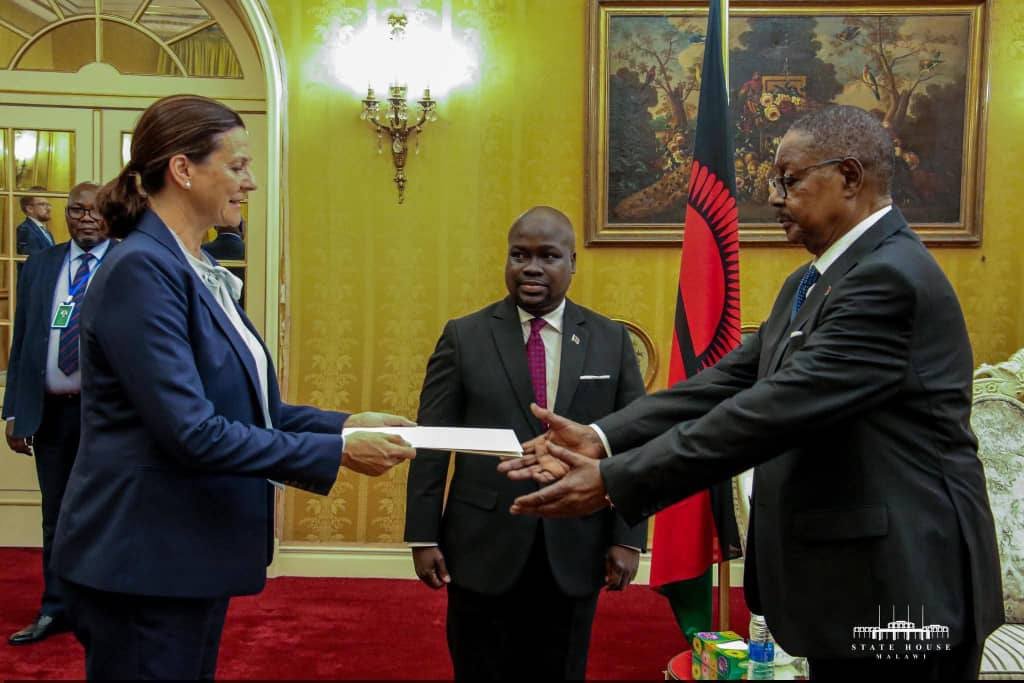
The United Kingdom’s new High Commissioner LEIGH STUBBLEFIELD is settling into her diplomatic post after presenting her credentials to President Peter Mutharika earlier this year. Stubblefield, who took up the role in November 2025, says the UK is reshaping its engagement with Malawi under a new Africa strategy that shifts emphasis from traditional donor aid toward partnerships driven by trade, private investment and long-term economic transformation. In this interview with our Lilongwe Bureau Chief EDYTH KAMBALAME, the new British envoy discusses the evolving UK-Malawi relationship, opportunities for investment, support for economic reforms, and cooperation in areas such as climate resilience, youth employment and governance.
You recently assumed office as the United Kingdom High Commissioner to Malawi. What are your first impressions of the country, and what excites you most about this assignment? Malawians have truly earned the country’s reputation as the Warm Heart of Africa, you feel that hospitality immediately.
What strikes me most is the energy and optimism I encounter, particularly among young people. Despite the real challenges Malawi faces, there is a strong entrepreneurial spirit and determination to build something better. I’ve visited markets, met farmers and spent time with young business owners, and that drive is evident everywhere.
[paywall]
What excites me most is the opportunity to contribute at a moment of real potential. The relationship between our two countries is deep and genuine, and I believe we can shape it in ways that deliver even more for people in both Malawi and the UK. For readers who may not fully understand the scope of your role, how would you describe the importance of the UK-Malawi relationship today?
At its core, my role is about partnership. I represent the UK, but more importantly I work to strengthen ties that benefit both our countries. The relationship is built on something real — shared history, shared values and shared interests.
We are connected through the Commonwealth, through around 20 000 Malawians living in the UK and about 7 500 British citizens here, as well as through trade, investment and educational links. But its importance is not just historical. Malawi sits at the heart of southern Africa, and the challenges it faces — climate change, economic development and health security — are not Malawi’s challenges alone.
They are regional and global. How we work together on them matters far beyond our two countries. Malawi and the UK share decades of historical ties.
How is this relationship evolving to reflect modern realities? Our ties run deep, but a good relationship cannot rely on history alone. It has to evolve and keep delivering.
What we are seeing now is a shift towards a more equal partnership. The UK recognises that older models of development assistance must change. We want approaches that support Malawi’s priorities, build local capacity and create opportunities for mutual benefit rather than dependency.
Trade and investment are becoming more central. We are looking at how British businesses can partner with Malawian enterprises and support sectors where Malawi has competitive advantages. At the same time, we are working together on shared global challenges, from climate change to health security — lessons reinforced by outbreaks such as Covid-19, mpox and polio, which reminded us how interconnected the world is.
What will be your top priorities during your tenure? Three priorities stand out. First is economic growth.
The UK government has made growth its top mission at home, and we want to support the same in partner countries — through trade, investment and job creation, particularly for young people. Second is resilience—resilience to climate shocks, health emergencies and economic pressures. Malawi has shown remarkable resilience, but we need to move from reacting to crises to building systems that can withstand them.
Third is governance and accountability. Not because the UK wants to lecture anyone, but because strong institutions, transparency and the rule of law are the foundations for sustainable growth and investor confidence. These priorities align closely with what Malawians themselves are calling for opportunities—stability and systems that people can trust.
How is British support shifting from traditional aid towards sustainable partnerships? The shift reflects a recognition that traditional aid models did not always deliver lasting change. In practice, this means focusing more on systems and capacity rather than delivering services directly.
In health, for example, we are not only funding medicines but helping strengthen supply chains, training health workers and improving data systems. Trade is another important element. Through the UK’s Developing Countries Trading Scheme, Malawi has duty-free access to the UK market for 99.8 percent of products.
We want to see more Malawian goods on British shelves and stronger trade links between our economies. We are also working more closely with the private sector, using development finance to support investments that can become sustainable without long-term subsidies. None of this means the UK is stepping away from its commitments.
The goal is to ensure our support leaves something lasting behind. Which sectors present the strongest opportunities for UK-Malawi cooperation and British investment? Three stand out.
Agriculture and agribusiness is at the top of the list. Malawi has strong fundamentals — fertile land, water resources and a hardworking farming population. The opportunity is to move up the value chain, from raw commodities to processed products linked to regional and global markets.
Second is digital technology and services. Malawi has a young and increasingly connected population, and the government has ambitious plans for digital transformation. We are already seeing promising tech entrepreneurship.
Third is clean energy. Malawi’s energy deficit holds back growth across the economy, yet the country has strong renewable potential—solar, hydro and possibly geothermal energy. British companies have global expertise in this sector and could play an important role.
Malawi continues to face economic pressures, including foreign exchange shortages and rising living costs. How can the UK help?
[/paywall]
All Zim News – Bringing you the latest news and updates.
