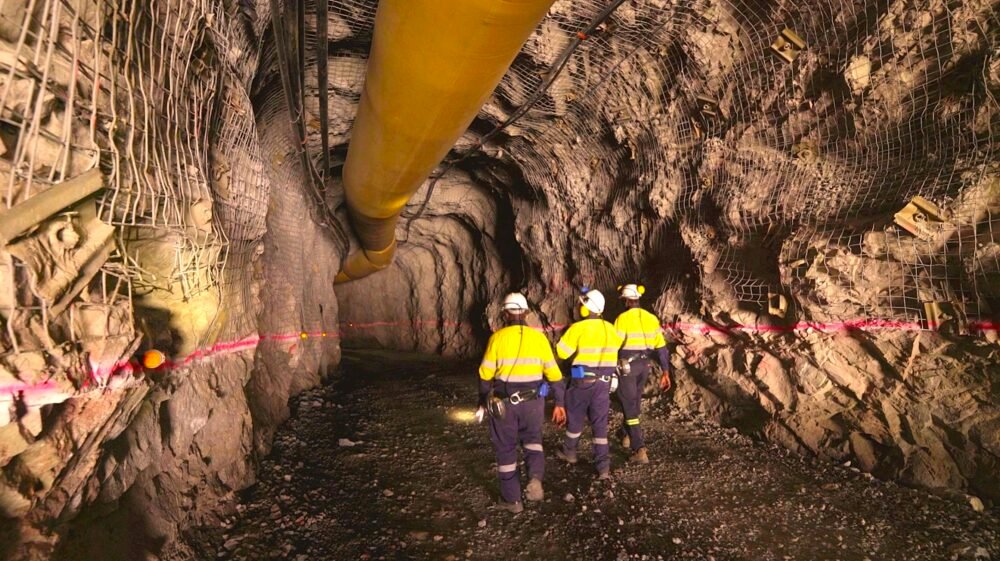
Imagine a world without appliances. Or one without weapons, vehicles, electricity or smartphones. For some of you reading this, that sounds like bliss.
But even a remote cottage in the Karoo requires the stone to have been quarried, hewn and chiselled from somewhere. The glass in the windows required mined material to be constructed. You can’t escape the adage that “if it’s not farmed, it’s mined” and vice versa.
For most of us reading this column, we cannot imagine a world without the myriad products derived from mining. And most of us probably know by now that feeding a low-carbon future economy will require more mining, not less, over the next 50 years. But mining is a complex game.
Read Full Article on Mail & Guardian
[paywall]
It typically requires long lead times to move from exploration to production. Companies that invest in these projects need sufficiently deep capital to withstand commodity price fluctuations and tricky political time cycles. There is also often a tension between generating long-run shared value and satisfying short-term shareholder interests.
The latter is a function of the reality that without shareholder cash, projects don’t get started. That’s especially the case with exploration, as exploring for mineral deposits is literally defined as “capital at risk”. Much of the developing world remains geologically undermapped.
Talking of geology and exploration, the statistic too often thrown around at various events is that Africa possesses roughly 30% of the world’s remaining minerals; a figure published in an academic journal but which turns out not to possess much substance by way of being verifiable. And, of course, any analyst must ask what that figure even means – are those deposits viable? What kind of grades are they and what are their long-term prospects given constantly shifting demand profiles?
Energy and transport revolutions away from fossil-fuel dependence add a particularly daunting dimension to this matrix because we do not know how the price of minerals such as lithium, cobalt, tantalum and graphite is going to behave in the future or exactly what the shape of the demand curve is likely to be. Historically, you could be assured that copper and gold, for instance, would be viable investments. That held more for gold than copper.
Both commodities remain in massive demand today. I came across an analysis I wrote in 2018 forecasting that gold would go beyond US$4 000/oz. It was almost inconceivable back then but in the past few months we’ve seen gold go beyond US$5 000/oz.
The repercussions are intense and many African deposits that were previously marginal are now thoroughly exploitable. So, yes, we know that Africa is well endowed with minerals that the world is likely to need over the next 50 years – for electric vehicles, military equipment, renewable energy technology and safe-fail infrastructure in the context of climate change. But we largely do not know to what extent, where and what it would take to extract that material responsibly from the ground in a way that would actually benefit African citizens and not destroy the environment in the process.
Beyond this, resource wealth in institutionally weak contexts tends to generate underdevelopment. Institutions – the cultures, beliefs, values and norms that motivate regular human behaviour – are all important for establishing appropriate rules of the game to ensure a broad-based distribution of mineral rents. As we know all too well, too many contexts on our continent lack the kind of institutions required to ensure that mineral wealth catalyses development.
In the absence of inclusive institutions, powerful elites strike bargains with extractors that yield rents for a few, often at the expense of the many. Those rents are distributed to as many people within a patronage circle as are deemed necessary not to threaten the bargain. Essentially, elites use mineral rents to purchase insurance policies that allow them to maintain access to wealth and power.
In too many jurisdictions, ruling elites see the costs of reform (in the direction of democratic consolidation) as far higher than the costs of repression (often funded by mineral rents). So, in a world awash with talk of “critical minerals” – critical for sustaining a “just” transition away from fossil fuels and securing reliable supply chains for various technologies – how are we going to form institutions that generate incentives away from predatory elite bargains and towards broad-based development? In a nutshell, we need to establish viable incentives for leaders to change the nature of the bargains that currently characterise mineral-rich jurisdictions.
In other words, community leaders (especially in near-mine communities) need to be empowered to build deals with mining companies that ensure sustained benefit from mining. Mining company leaders need to take a longer view and see the value in doing right by the state, the community and the environment. Finally, governments need to believe that establishing reliable, consistent and predictable rules of the game will yield sufficient development gain to make their tenure more secure.
Botswana managed to build a phenomenal deal with De Beers back in the 1960s. Of course, there is much that was unique about that situation that doesn’t necessarily apply in other jurisdictions. Nonetheless, it shows what is possible when leaders take a longer view instead of one that results in myopic trough-feeding that fattens a few today but leads to starvation for the many tomorrow. Ross Harvey is the director of research and programmes at Good Governance Africa.
[/paywall]
All Zim News – Bringing you the latest news and updates.
