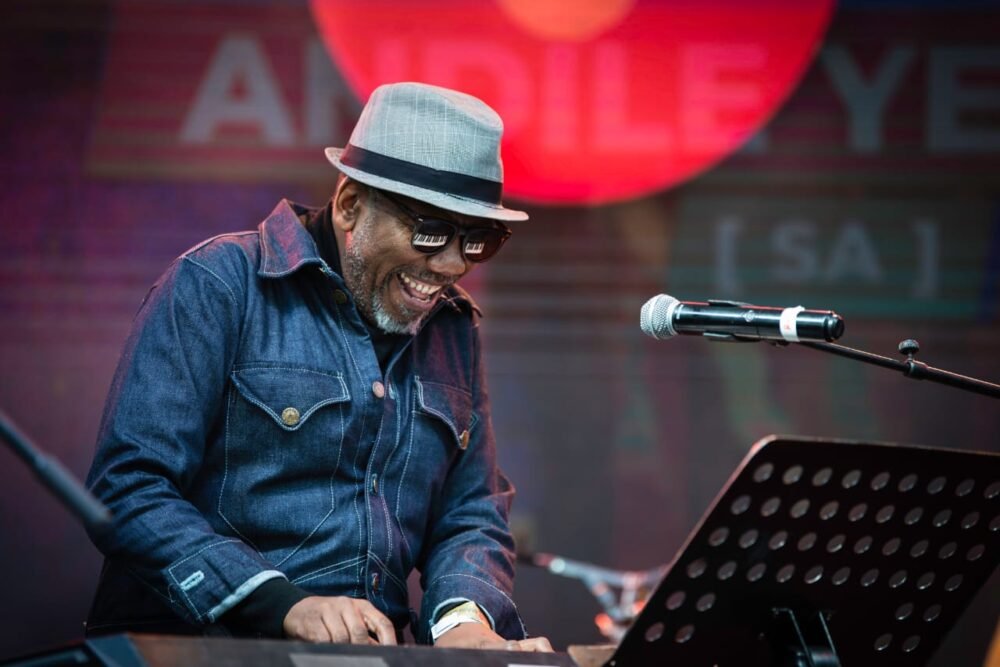
When Andile Yenana talks about the process of recording his latest album, there is no sense of drama in his voice. He speaks about time, patience and listening – to music, to culture and to himself.Way Out Is In, his first solo album in 20 years, feels less like a re-entry than a quiet arrival at a place he has been moving towards all along. Recorded live at the Bird’s Eye Jazz Club in Basel, Switzerland,Way Out Is Incaptures Yenana at a point of reckoning.
It is a record shaped by decades of touring, teaching and collaboration, but also by withdrawal, reflection and the slow work of finding a voice that belongs fully to him. At 57, Yenana sounds neither nostalgic nor tentative. If anything, the album reveals an artist deeply comfortable with uncertainty, improvisation and the idea that learning never really ends.
Way Out Is Inwas recorded across several days in June 2018, as part of a long-running cultural exchange programme that has brought South African jazz musicians to Switzerland since the early 2000s. Yenana performed two nights at Bird’s Eye with a mixed ensemble that included long time collaborator Marcus Wyatt on trumpet, trombonist Siya Charles and Swiss musicians he had already developed a rapport with during an earlier visit. Those first two nights were recorded in front of a live audience, followed by a third day in the same venue without an audience present.
Read Full Article on Mail & Guardian
[paywall]
Yenana later drew from both sessions, selecting roughly 60 percent from the live recordings and 40 percent from the closed set to complete the album. The decision to record live was central to the project. For Yenana, improvisation is not a stylistic flourish but a philosophy.
“I didn’t even have charts written,” he says. “That’s how I was taught. And that’s what I did with them as well.” That openness extended to how the music unfolded on stage.
Bird’s Eye, a revered jazz venue that regularly hosts international artists, offered a listening culture very different from what Yenana was used to back home. Audiences listened intently, applauded generously and waited for pauses before responding. On the first night, he found himself slightly disoriented.
“In South Africa, people are drinking, talking, moving around,” he recalls. “If they clap, you’re thinking about how to get them back into the groove. Here, when you finish, they clap properly.
I wasn’t ready for that.” He remembers starting the next piece before the applause had settled, only to realise the audience was responding to what had already passed. The shift mattered. For Yenana, performance is as much about sound as space. The piano, the room, the audience and the musicians form a single organism.
[/paywall]
All Zim News – Bringing you the latest news and updates.
