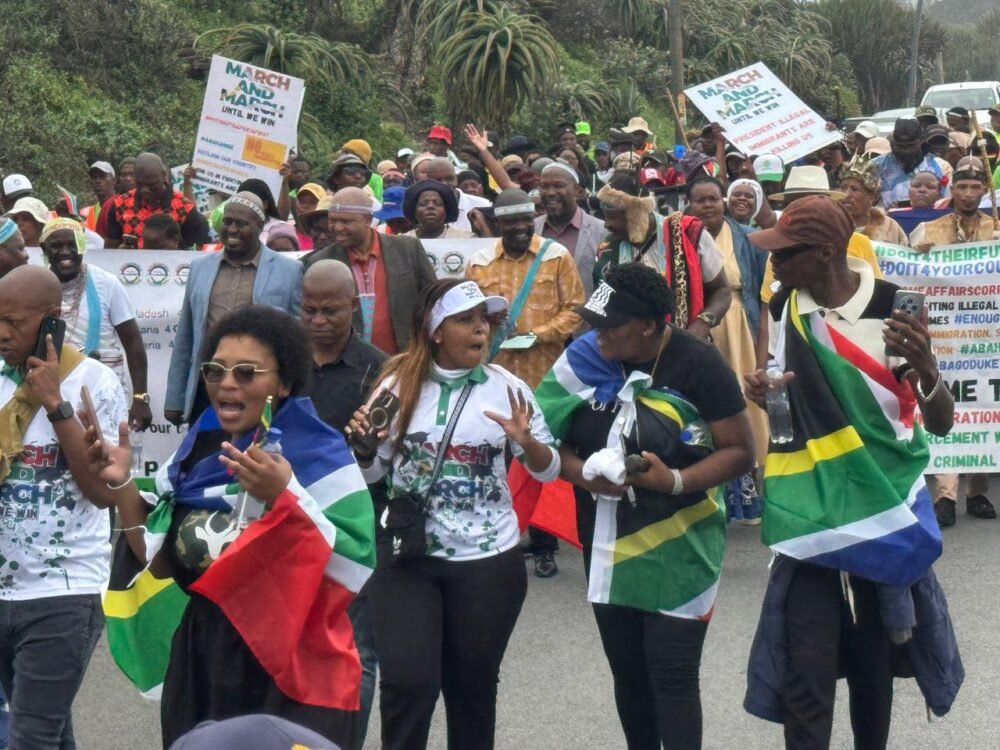
On Thursday 26 March 2026 ActionSA, the Inkatha Freedom Party (IFP) and the uMkhonto weSizwe party (MKP) joined the xenophobic group March on March in a march through central Durban. Migrants, as well as Pondo and Tsonga South Africans, were intimidated, with reports of assaults. March on March, backed by the MKP, previously attempted to prevent children of Congolese refugees from starting their first day of school, shouting abuse at them.
The attempt to blockade the school was illegal and morally indefensible. Yet much of the media continues to describe an organisation engaged in public abuse and unlawful activity as a “civil society” or “community” organisation. To describe xenophobic formations as civil society and their mobilisation as activism, misrepresents what is taking place.
Organisations such as Operation Dudula and March on March have a record of unlawful conduct, including attempts to blockade schools and hospitals and the harassment of migrants. In the case of Operation Dudula, this has at times escalated into serious violence. Migrants are also part of society.
Read Full Article on Mail & Guardian
[paywall]
What is often presented as “the community” is a faction asserting the right to exclude through intimidation. When the media adopts this framing, it does not merely describe events; it confers legitimacy. Xenophobia sits at the centre of right-wing politics globally.
In South Africa, parties such as ActionSA and the Patriotic Alliance follow a similar script to figures like Donald Trump and Nigel Farage. The MKP, although ideologically inconsistent, combines elements of authoritarian nationalism with xenophobic rhetoric. This is particularly concerning given its ethnic framing, militarised posture and association with violence.
As elections approach, parties including ActionSA, the IFP, the Patriotic Alliance and the MKP are likely to intensify their xenophobic rhetoric. Without credible plans to address the country’s social crisis, scapegoating migrants becomes a way to appear responsive to public frustration. Xenophobia offers a simple but misleading explanation for a complex crisis.
It reframes mass unemployment, failing public services and weak governance as a question of belonging. For parties without a viable programme, it creates the appearance of decisiveness while avoiding the underlying causes of social distress. There is also a history that cannot be ignored.
Xenophobic mobilisation in South Africa has repeatedly turned violent, with assaults and killings. When political parties align themselves with formations that normalise exclusion and harassment, they enter dangerous terrain with the potential for further violence. Globally, the most effective response to xenophobia has been inclusive, leftist politics grounded in social justice.
In South Africa, Abahlali baseMjondolo has directly confronted Operation Dudula on the streets, often at considerable risk. Zwelinzima Vavi has also emerged as a consistent voice within the trade union movement opposing xenophobia. Abahlali baseMjondolo has taken a clear public position against Operation Dudula and acted on it.
Vavi has been one of the few trade union leaders to oppose xenophobia without qualification. As with left formations elsewhere, xenophobia is explicitly named and opposed, not accommodated within political programmes. Internationally, figures such as Zohran Mamdani, Jeremy Corbyn and Zack Polanski have advanced inclusive political visions that challenge xenophobic politics.
Yet isolated efforts, however courageous, are not sufficient. Addressing xenophobia requires building a coherent left alternative.
[/paywall]
All Zim News – Bringing you the latest news and updates.
