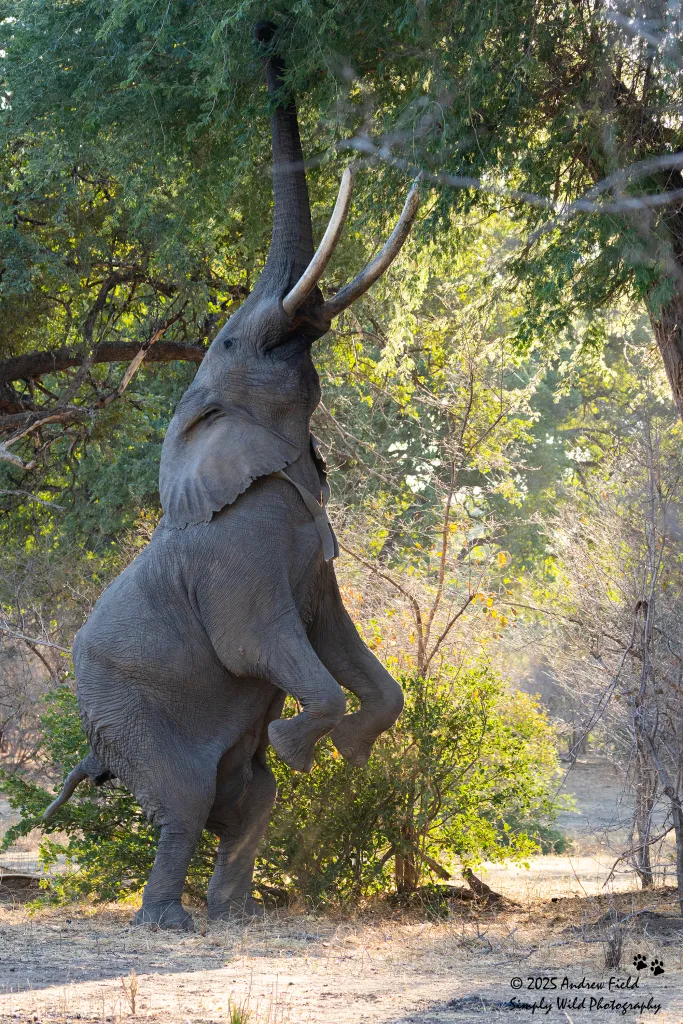
The late afternoon sun of the Zimbabwean dry season beat down upon the dusty expanse, turning the landscape into a study of scorched browns and pale gold. Credit: Andrew FieldBy Etiwel MuteroIt was a world defined by the unrelenting thirst for the distant waterhole, and into this harsh beauty strode the monarch of the Mopane scrub: a truly immense bull elephant, known by the local trackers simply as The Colossus. To witness him was not merely to observe an animal; it was to stand in the presence of a living, breathing, ancient monument.His sheer size was the first, staggering impression.
He stood taller than two men, a walking hillock of granite-grey muscle and bone. His form was less like a mammal and more like a great, geological formation that had somehow learned to move. The weight of his presence seemed to compress the very atmosphere around him, forcing the world into quiet reverence.
Every step was deliberate, a slow, earth-trembling thump that spoke of mass and unhurried confidence. He was the definition of power made patient.The elephant’s hide was a masterpiece of texture and history. It was not smooth, but a deeply furrowed landscape, a map of every migration, every battle, and every drought he had survived.
Read Full Article on The Zimbabwean
[paywall]
The skin was the colour of dried river mud and charcoal, shot through with patches of reddish Kalahari dust where he had recently tossed soil onto his flanks for cooling. These great, hanging folds of flesh around his shoulders and legs gave him an archaic, armor-plated appearance. Thousands of tiny, rigid bristles, like iron filings, dotted the surface, lending the texture a roughness that defied the sun’s soft light.
Here and there, one could spot the pale pink scar tissue—faded medals of endurance acquired from tussles with rivals or scrapes against thorny acacia branches—each marking a chapter in his long, solitary existence.Above this mountainous bulk was the immense skull, dominated by two perfect, curving tusks. These were the ivory trophies of his age and success, polished smooth at the tips from decades of scraping against rocks, levering up tough roots, and marking trees. They tapered to sharp points, glistening faintly even under the dust, serving as both intimidating weapons and exquisitely fine-tuned sensory tools.But the most mesmerizing feature was his trunk—the great, liquid whip of muscle, cartilage, and sensitivity.
It was a five-foot-long instrument of unparalleled dexterity. You could watch it move with the fluidity of a striking cobra, yet perform a task requiring the gentleness of a human hand. In one moment, it flared wide at the tip, testing the air for the scent of distant water or danger.
In the next, it was curling with infinite precision, plucking a single, green shoot, or delicately siphoning up a mouthful of water from the remaining damp mud of a shrinking pool. When he drank, the trunk plunged deep, drawing in gallons with a single, powerful suction, before curling upward and emptying the refreshing deluge directly into his mouth with an audible, satisfying slosh.His ears, vast and wing-like, were perpetually in motion. They were enormous, intricate fans of thin skin, latticed with pronounced veins that resembled the tributaries of the great Zambezi River.
With a slow, languid rhythm, they flapped, creating an almost silent whoosh of displaced air, working as the essential biological radiator to cool his massive internal furnace. The movement gave his profile a serene, almost philosophical quality, as if he were patiently signalling to the surrounding savanna.Contrasting sharply with his huge scale were his eyes: surprisingly small, dark, and set deep within the folds of his face. Yet, they were windows to an unreadable, profound intelligence.
They held no malice, only the deep-seated weariness and wisdom of generations. As he stopped beneath a towering African teak, the elephant shifted his weight, and a low, resonant rumble resonated from his chest. This infrasonic communication, too low for the human ear to truly comprehend, vibrated through the earth itself, a silent dialogue with the dispersed herd scattered across the plains.
It was the sound of kinship and connection, the heartbeat of the bush.He moved toward the last remaining pool, and the moment he reached it, the pace of his action shifted. He began to apply a generous coat of thick, grey mud, using his trunk to plaster it onto his head and back with purposeful swings. The mud bath was a luxury, a cooling balm, and a defense against biting insects, transforming the Colossus briefly from a dust-coloured giant into a figure molded from wet, living clay.
When he emerged, his silhouette against the setting sun was magnificent: a creature reborn in the cool, momentary protection of the earth.The Zimbabwean elephant is more than just a magnificent beast; he is the custodian of the continent’s memory, a living metaphor for enduring wildness. His ancient, thoughtful presence anchors the landscape, reminding all who watch that scale, patience, and deep connection to the earth remain the highest forms of sovereignty in the wild heart of Africa.Etiwel Mutero is a teacher, archivist, librarian and a political analyst .You can contact him on +263773614293 oretiwelm02@gmail.comPost published in:Featured It was a world defined by the unrelenting thirst for the distant waterhole, and into this harsh beauty strode the monarch of the Mopane scrub: a truly immense bull elephant, known by the local trackers simply as The Colossus. To witness him was not merely to observe an animal; it was to stand in the presence of a living, breathing, ancient monument.
His sheer size was the first, staggering impression. He was the definition of power made patient. The elephant’s hide was a masterpiece of texture and history.
Here and there, one could spot the pale pink scar tissue—faded medals of endurance acquired from tussles with rivals or scrapes against thorny acacia branches—each marking a chapter in his long, solitary existence. Above this mountainous bulk was the immense skull, dominated by two perfect, curving tusks. They tapered to sharp points, glistening faintly even under the dust, serving as both intimidating weapons and exquisitely fine-tuned sensory tools.
But the most mesmerizing feature was his trunk—the great, liquid whip of muscle, cartilage, and sensitivity. When he drank, the trunk plunged deep, drawing in gallons with a single, powerful suction, before curling upward and emptying the refreshing deluge directly into his mouth with an audible, satisfying slosh. His ears, vast and wing-like, were perpetually in motion.
The movement gave his profile a serene, almost philosophical quality, as if he were patiently signalling to the surrounding savanna. Contrasting sharply with his huge scale were his eyes: surprisingly small, dark, and set deep within the folds of his face. It was the sound of kinship and connection, the heartbeat of the bush.
[/paywall]
