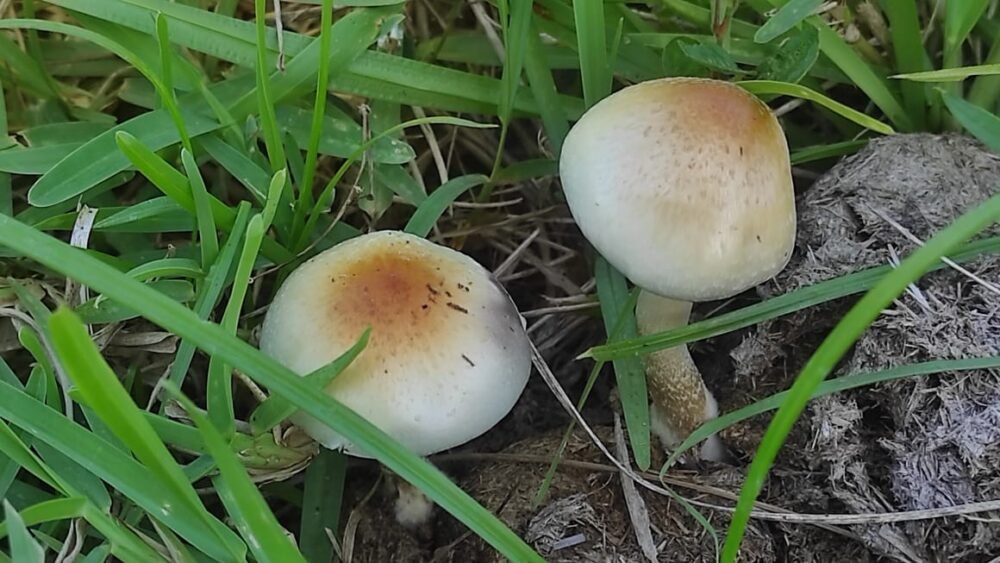
After decades of mystery, the evolutionary tale of the world’s most famous “magic mushroom”,Psilocybe cubensis, is finally coming to light and it’s rooted in Africa. Scientists from Southern Africa and the US have uncovered a previously unknown relative, the crypticPsilocybe ochraceocentrata, thriving in the grasslands of South Africa and Zimbabwe. Their findings are documented in a paper published in the journal,Proceedings B of the Royal Society.
Named for the ochre-yellow centre of its cap, the distinctiveP. ochraceocentratalast shared a common ancestor withP. cubensis— the most widely known, collected and cultivated magic mushroom in the world — about 1.5 million years ago.
This overturns the long-held belief thatP. cubensisonly made its way to the Americas in the 1500s, with European-introduced cattle. Breyten van der Merwe, a mycologist and PhD student at Stellenbosch University, said the discovery shed new light on the wild origins of the mushroom that had been cultivated and celebrated worldwide.
Read Full Article on Mail & Guardian
[paywall]
“Even thoughP. cubensisandP. ochraceocentratalook alike, they are genetically, ecologically and chemically distinct,” he said.
Interestingly,P. ochraceocentratais not entirely unknown to cultivators. For years, it has been grown under the names “NSS” (Natal Super Strength) or “Transkei”.
An international team, including Dr Alexander Bradshaw (Clark University), professor Bryn Dentinger (University of Utah Health), Dr Keaton Tremble (Duke University) and Dr Cathy Sharp (Natural History Museum of Zimbabwe), traced the fungus’ lineage using DNA from modern collections and historic specimens, employing phylogenetic analysis, molecular clock dating and ecological niche modelling. Sharp first collected specimens in Zimbabwe in 2013, highlighting how Africa, the original home of the mushrooms, remained vastly underexplored when it came to fungal diversity. The authors suggest several possible scenarios for when and how the species diverged many millions of years ago. Around this time, grasslands were diversifying in South America and grazing herbivores, which provide food for these mushrooms to grow on, were expanding out of Africa and into Eurasia.
[/paywall]
All Zim News – Bringing you the latest news and updates.
