Recent statistics released by Statistics South Africa (Stats SA) indicate that poverty in South Africa has worsened to the proportions of a national emergency. According to the National Poverty Headcounts Report, the upper-bound poverty line is now set at R2 846, the lower-bound poverty line at R1 415, and the food poverty line at R855. An examination of absolute poverty between 2006 and 2023 by Statistics South Africa indicates that approximately 66.7% of the South African population lives below the upper-bound poverty line, while another 17.6% lives below the food poverty line, struggling to meet minimum monthly food requirements.
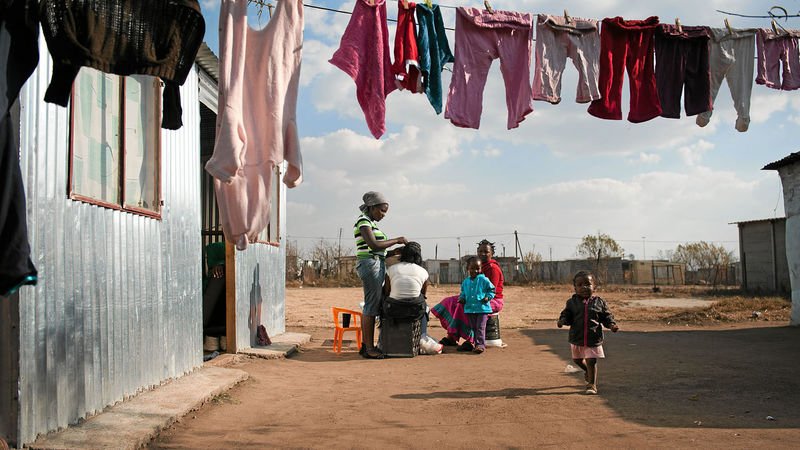
These statistics indicate that poverty in South Africa is no longer just a social issue but an assault on dignity and hope, impacting the very ethos of democracy. In the deep rural villages of Limpopo, hunger sits on the faces of children like an inherited curse. In the informal settlements of Gauteng, families of five cram into one-room shacks, cooking on paraffin stoves while smoke chokes both lungs and ambition.
In the dying towns of the Free State, young men drift on pavements with nothing but dangerous amounts of time. In these communities, poverty is not an abstraction; it has a distinct smell, texture and temperature. It lives in the false hopes of the unemployed, the empty fridges of the working poor and the silent desperation of those who have stopped looking for opportunities because opportunities have long stopped looking for them.
Read Full Article on Mail & Guardian
[paywall]
The recent fire outbreak in Dunoon informal settlement in the City of Cape Town underscores the structural nature of poverty in South Africa. Hundreds of households lost their homes in a settlement that exists not because of choice but because of exclusion from formal housing and labour markets. Informal settlements such as Dunoon are the residual outcome of insufficient affordable housing supply, constrained urban land markets and slow, fragmented state delivery.
When fires break out in places such as Dunoon, or when climate disasters displace people in poor rural Limpopo, they expose the cumulative effects of policy gaps in human settlements, energy access and local infrastructure. These incidents should be understood less as isolated disasters and more as predictable risks, embedded in a development model that has struggled to integrate poor households safely into spatial planning. South Africa will not inch its way out of this crisis.
It must wage a fully fledged war against poverty with strategy, discipline and national moral conviction. And it must wage it now. Eradicating absolute poverty is not impossible, but it will require more action than South Africa’s typical policy reviews.
Between 1980 and 2020, China lifted more than 800 million people out of extreme poverty, the single largest poverty-reduction endeavour in human history. The lesson is not that China is exceptional; it is that China made poverty reduction a national obsession. It weaponised industrial policy, coordinated local governance with central planning, fought corruption ruthlessly and poured investment into rural infrastructure, integrating once-desolate regions into the national economy.
We are no different from China in our ambition for dignity, security and progress. But we differ in our execution. Where China disciplines its bureaucracy, ours often buckles under corruption, inefficiency and political infighting.
Where China built industries, we often romanticise reindustrialisation while factories close shop. Where China mobilised every layer of the state towards one mission, South Africa scatters its efforts into siloed, uncoordinated programmes that spend billions but move the poverty needle by millimetres. But the biggest difference is this: China treated poverty as the enemy.
South Africa treats it as a recurring inconvenience. To wage a real war against poverty, the country needs a battle plan anchored in three pillars: economic reconstruction, human capital activation and community resilience. First, South Africa needs an economy that produces jobs on a large scale.
This demands industrial policy with special economic zones that function, agro-processing corridors that connect small farmers to real markets, green industrialisation that is not trapped in pilot projects and procurement systems that reward performance instead of patronage. Second, South Africa must weaponise education and skills. A child in Sandton is not more intelligent than a child in Giyani.
One simply has access to functioning schools, textbooks, teachers and amenities, including domestic environments conducive to learning. A war on poverty means an education system so well equipped and well managed that every child, whether in Langa or Constantia, has an equal shot at opportunity.
[/paywall]
All Zim News – Bringing you the latest news and updates.
