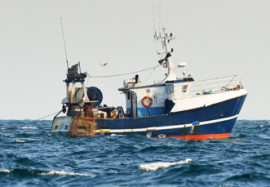
Four Chinese-flagged fishing vessels were intercepted in South Africa’sExclusive Economic Zone(EEZ) and territorial waters after entering without proper authorisation, authorities confirmed on Thursday. The vessels — Zhong Yang 231, Zhong Yang 232, Zhong Yang 233 and Zhong Yang 239 — were placed under guard at the Port of Cape Town anchorage by the South African Police Service (SAPS) tactical team and fishery control officers while compliance procedures were finalised with the vessels’ owner, Shenzhen Shuiwan Pelagic Fisheries Co Ltd. Willie Aucamp, the minister of forestry, fisheries and the environment, said the operation demonstrated South Africa’s commitment to protecting its marine resources.
“South Africa will not tolerate the unlawful use of its maritime zones. Compliance with our laws is non-negotiable.” The vessels had initially requested permission on 23 February 2026 to pass through the EEZ under “innocent passage”, indicating that they would exit by 3 March. On 27 February, the South African Maritime Safety Authority rejected a subsequent request for off-port limits (OPL) authorisation because of missing documentation and justification.
The department said its investigations revealed that the vessels had entered territorial waters during the pending OPL request. They were detected within 12 nautical miles of the KwaZulu-Natal coast and later tracked along the Eastern Cape coastline. Authorities noted that the vessels repeatedly switched their automatic identification system (AIS) on and off, violating regulations requiring foreign vessels to maintain AIS for navigational safety.
Read Full Article on Mail & Guardian
[paywall]
The department said the action underscored South Africa’s commitment to “safeguarding its EEZ, protecting marine resources and strengthening international cooperation against illegal, unreported and unregulated fishing”. Andrew de Blocq, the Democratic Alliance spokesperson for forestry, fisheries and the environment, welcomed the interception and fining of the four Chinese vessels. That the vessels had repeatedly switched their AIS signals off and back on while inside the EEZ was “highly suspicious”, he said, noting that continuous AIS broadcasting was required under South African law for safety, monitoring and maritime security. The deliberate disabling of AIS “raises legitimate questions about what activities or movements the vessels may have been attempting to conceal”.
[/paywall]
All Zim News – Bringing you the latest news and updates.
