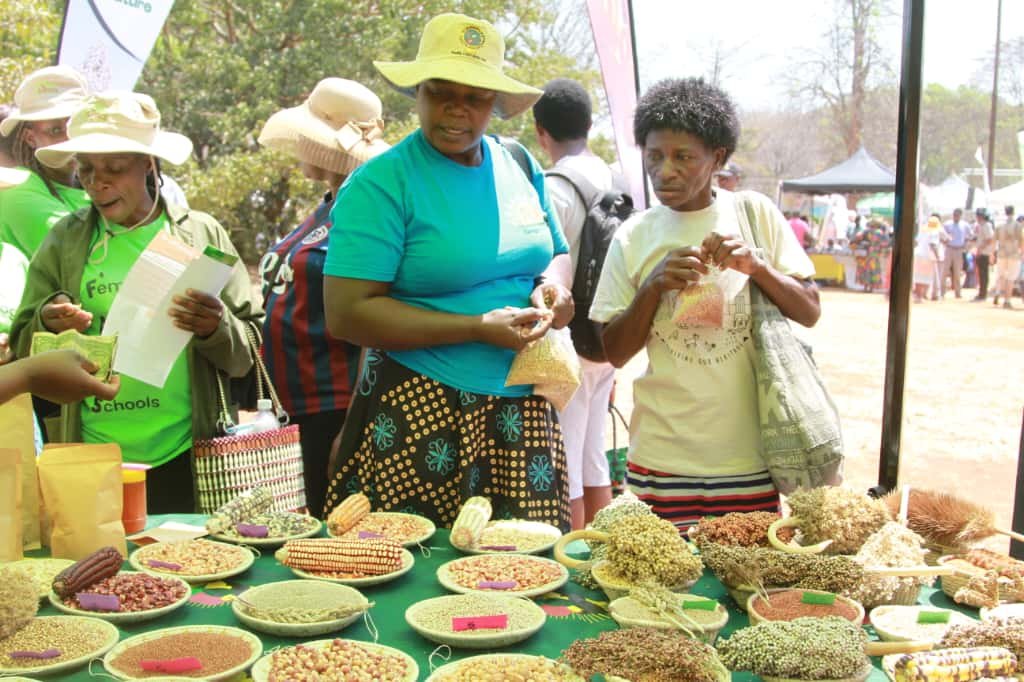
HARARE, October 1 – As farmers in Zimbabwe face uncertainties due to climate-induced shocks, seed exchanges are shielding smallholder farmers from recurring droughts by fostering locally adapted seed systems. Sixty-year-old Spiwe Ngwenya, a smallholder farmer from Nkayi, said seed exchange and growing a variety of indigenous seeds enabled her to become food self-sufficient and more resilient to droughts. “To me seed exchange is very important.
I don’t have to buy seeds. I just keep my own, and I can store as many varieties as I can. I can organically grow indigenous crops, and that saves me from needing chemicals,” said Ngwenya during the National Good Seed and Food Festival held in Harare recently.
Ngwenya, is a member of the Zimbabwe Smallholder Organic Farmers’ Forum (ZIMSOFF), an organization that envisions improved livelihoods of organized and empowered smallholder farmers in Ziwmbabwe practicing sustainable and viable ecological agriculture. She said it is important to revive traditional ways of growing crops as the ecological age-old techniques have sustained generations.“We want to revive our culture, so we want our children to learn how to grow our traditional crops such as groundnuts, finger millet, sorghum, crops such as cowpeas,” said Ngwenya. Due to seed exchange and knowledge sharing, many farmers are increasingly cultivating locally adapted traditional crops due to their proven drought tolerance and nutritional value, she said.
Read Full Article on ExpressMail Zimbabwe
[paywall]
“Seed exchanges have been carried on from our ancestors, it’s a longstanding culture that creates a bond between people,” said Chinyoka. Due to their critical role in preserving indigenous seeds, Chinyoka said smallholder farmers are being recognized as the primary guardians of food security and cultural heritage. “As farmers, we are now visible and recognized because people are realizing that we are the custodians of our traditions, which means even the next generations will benefit from this tradition,” said Chinyoka.Thanks to seed exchanges, some lost traditional seeds have been revived, said Chinyoka.
“We had seeds that were going extinct, but now they have been revived, thanks to seed exchanges. If I exchange seeds with other farmers. If my crop fails due to drought or other reasons, I can always get the seed from other farmers,” he noted.
Speaking at the seed festival, Dumisani Kutywayo, the Chief Director in the Department of Research and Specialist Services, Ministry of Lands, Agriculture, Fisheries, Water and Rural Development, said farmer-led seed systems are the backbone of seed and food sovereignty, which is the only path to food and nutrition security in the face of the climate crisis. “Let us celebrate the diversity of our seeds not just in their varieties, but in the stories, cultures, and communities they represent. Let us renew our commitment to a food system that is fair, ecological, and resilient, where farmers lead, and nature is respected,” he added.
[/paywall]
