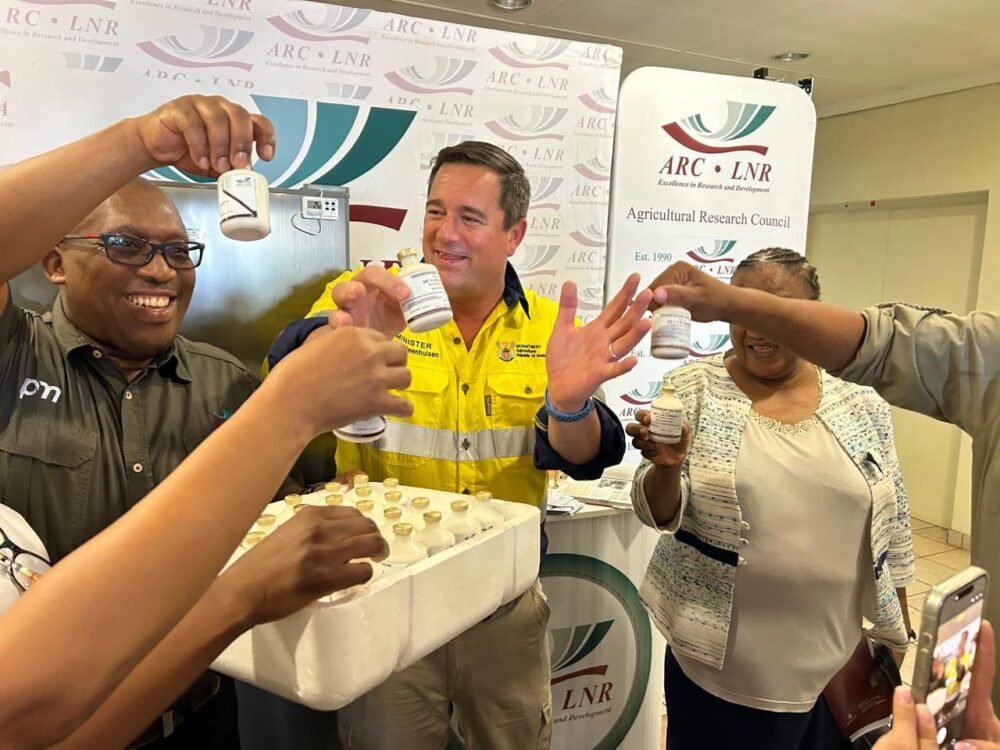
South Africa’s first locally-producedfoot-and-mouth disease(FMD) vaccines in 21 years were formally handed over at the Onderstepoort Veterinary Research facility of the Agricultural Research Council (ARC) on Friday. The initial batch of 12 900 doses – produced at pilot scale using modern bioreactor technology – will be distributed across six provinces, with the Eastern Cape and Free State receiving the largest allocations. Agriculture MinisterJohn Steenhuisen, on site to witness the finalisation of the doses, framed the breakthrough as a “shift from reactive disease control to a proactive, science-led campaign” to reclaim South Africa’s FMD-free status — lost in 2019 — with the World Organisation for Animal Health.
From March, the ARC is expected to produce 20 000 doses per week, scaling up to 200 000 weekly doses from 2027, while imported vaccines from Botswana, Argentina and Turkey are intended to bridge the gap during the rollout. Steenhuisen paired the technical announcement with an emotive appeal to farmers, acknowledging the “severe emotional and financial toll” caused by repeated outbreaks, movement restrictions and lost livelihoods. “To our farmers who have watched their livelihoods disappear before their eyes, I hear you,” he said, promising that the government would “stop at nothing” to eradicate the disease and urging producers not to lose faith as a10-year strategy moves “from defence to offence”.
Central to that plan, the agriculture department argued, is a tightly controlled, state-led vaccination programme – a requirement to prove at least 12 months of zero virus transmission and protect export markets. The department pushed back against criticism of the government’s vaccine strategy, stressing that Steenhuisen and the department do not oppose the use of designated private agents to import vaccines – such as Design Biologix for Argentina’s Biogénesis Bagó and Dunevax for Turkey’s Dollvet – but rejects calls for a “vaccine free-for-all”. Such proposals, it said, are “short-sighted and reckless” and risk undermining biosecurity, citing the dangers posed by illegally imported vaccines already detected in KwaZulu-Natal.
Read Full Article on Mail & Guardian
[paywall]
The department insisted that private veterinarians, industry bodies and agricultural organisations have been consulted throughout, from the initial FMD Lekgotla to the establishment of a ministerial task team and industry coordination council. “The priority is the consistent arrival of vaccines, not the specific procurement channel.” That defence, however, has done little to quell growing resistance from parts of the farming and business community. Sakeliga, which is part of a groupthreatening imminent legal action, has accused the minister of refusing to clearly state the legal basis for restricting private vaccine procurement and distribution, arguing that the department’s stance may be unlawful and economically damaging.
[/paywall]
All Zim News – Bringing you the latest news and updates.
