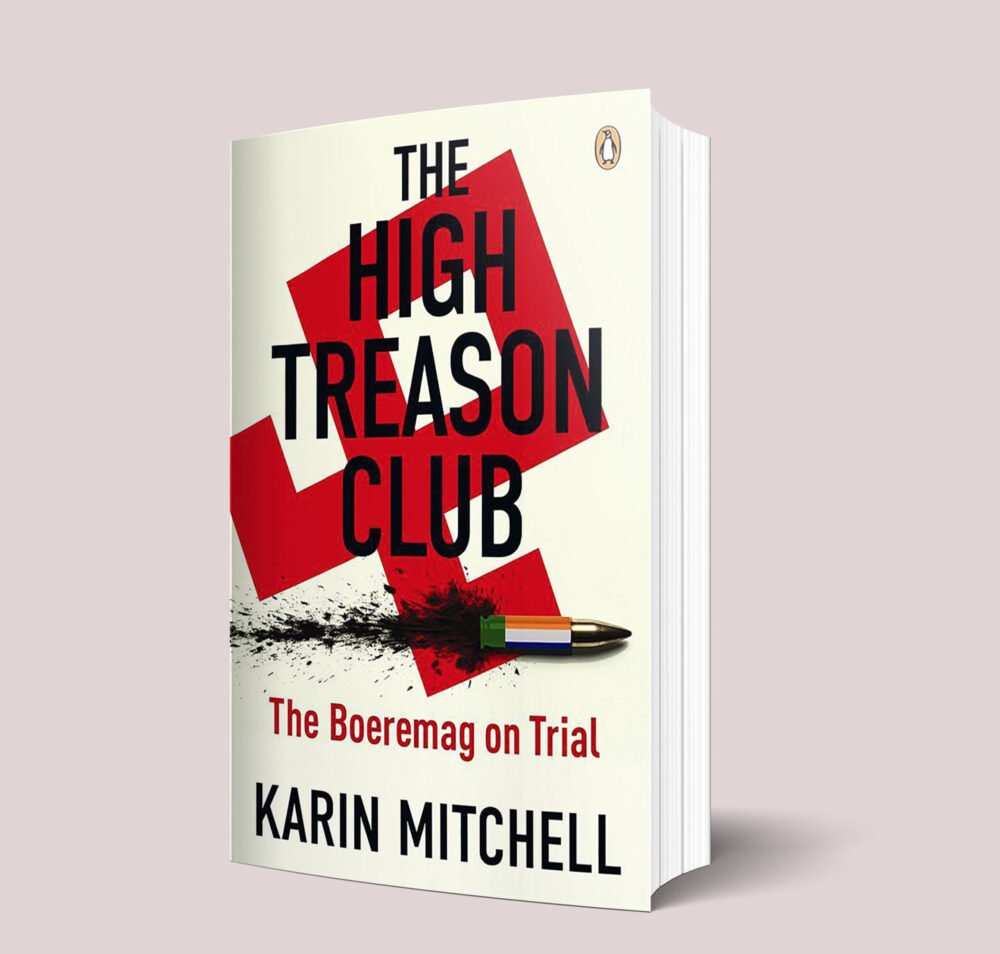
South Africa’s democratic story has never lacked drama but few chapters are as unsettling or as under-told as the Boeremag saga. InThe High Treason Club: The Boeremag On Trial, journalist-turned-author Karin Mitchell excavates this dark, disquieting moment with the precision and passion of a reporter and the narrative instinct of a storyteller determined to ensure that history does not slip quietly into the archives. Mitchell’s 352-page account is more than a reconstruction of a treason trial.
It is a reminder of the journalist’s duty to bear witness, to turn daily dispatches into a durable record and to resist the temptation, so common in newsrooms, to let extraordinary stories fade into the fog of yesterday’s deadlines. Her book is, in many ways, a rebuke to procrastination: a call to write the stories only we can tell. Mitchell was an intern when she was thrown into the deep end of the Boeremag case — a sprawling, ideologically charged and logistically punishing assignment that would test even veteran reporters.
It was her first major story and it would follow her for more than a decade. She covered the trial day after day, filing hourly bulletins from a public payphone when cellphone reception failed, navigating the procedural grind of one of the longest and most complex cases in democratic South Africa. Her book is the culmination of that long apprenticeship: a decades-long journey to bring home the full story of a group of white supremacist extremists who believed they could plunge Mandela’s South Africa into chaos and resurrect a Boer republic.
Read Full Article on Mail & Guardian
[paywall]
Mitchell revisits the early 2000s, when the Boeremag emerged from the ashes of apartheid as a far right, millenarian movement convinced that democracy was a historical aberration. Their plans were astonishing in their audacity: bomb attacks across Soweto, stockpiles of explosives. Most chillingly, a plot to assassinate Nelson Mandela, the global symbol of reconciliation whose leadership had earned South Africa the moniker “Darling of Democracy”.
What, Mitchell asks implicitly, were they thinking? How did a group of men convince themselves that they could reverse history, topple a democratic government and install a breakaway Boer state? Her narrative does not sensationalise.
Instead, she traces the ideological currents — racial nationalism, prophecy, paranoia, brands of politics and a quasi-religious belief in a coming volkstaat — that fused into a combustible political theology. The result is a portrait of extremism that feels disturbingly contemporary in a world grappling with resurgent right-wing militancy. Mitchell’s strength lies in her ability to animate the procedural machinery of the trial without losing sight of its human stakes.
She draws on thousands of pages of transcripts, years of reporting and her own front-seat proximity to the case to reconstruct the investigation: the painstaking work of police and intelligence operatives, the arrests, the bomb sites, the forensic breakthroughs and the ideological fervour that sustained the accused. The book’s pacing mirrors the trial itself: slow burning, meticulous, punctuated by moments of revelation. Mitchell brings to life the investigators, prosecutors, defence lawyers and the accused themselves, not as caricatures but as people shaped by history, belief and circumstance.
Colonel Tollie Vreugdenburg, the lead investigator, emerges as a central figure — a man whose team’s work earned national recognition. Mitchell includes a striking photograph of him receiving the Best Major Case Investigation Team Award from then-police commissioner Riah Phiyega, a moment shadowed by the later tragedy of Marikana under her watch.
[/paywall]
All Zim News – Bringing you the latest news and updates.
