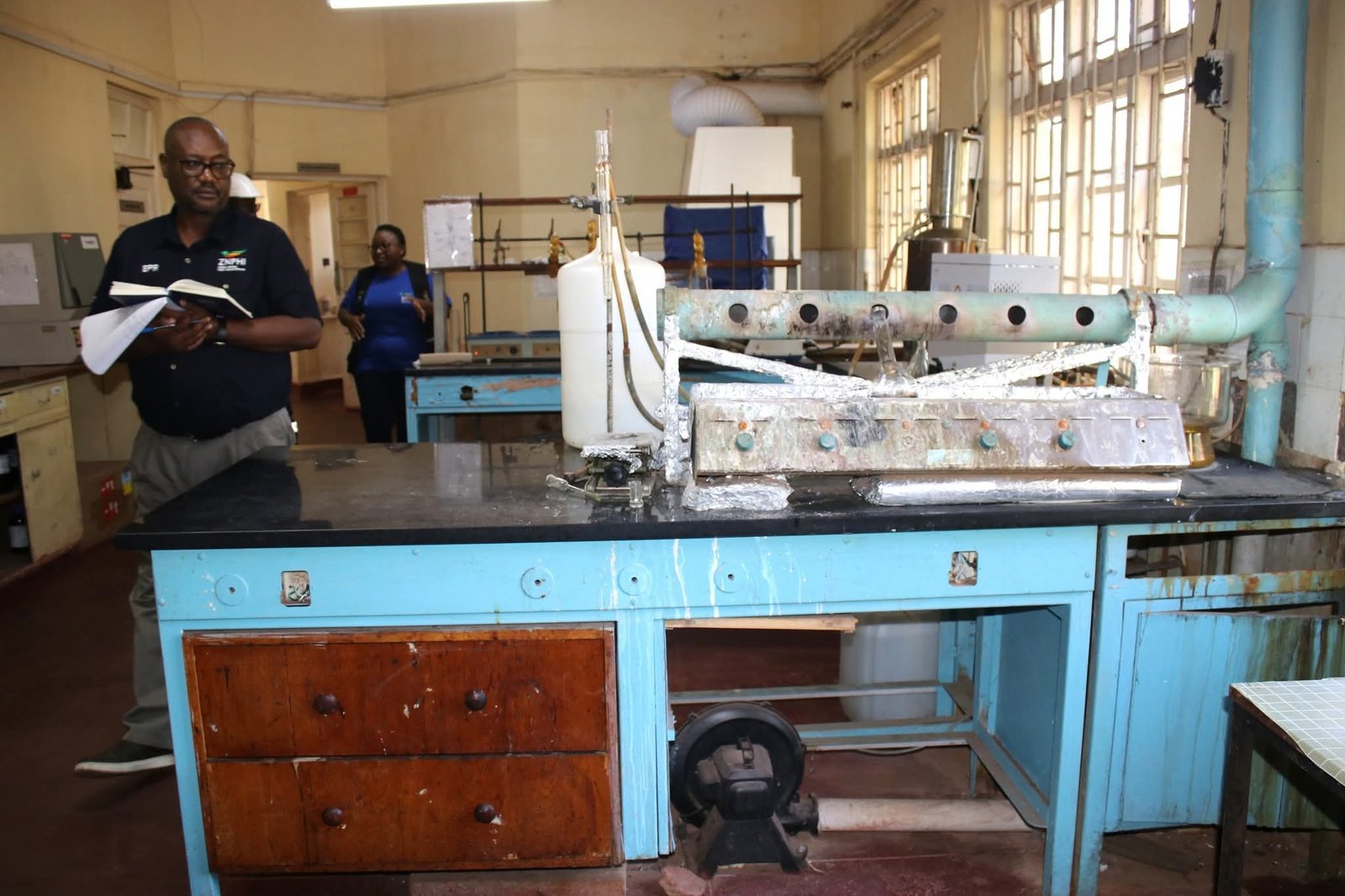
The Zambia National Public Health Institute (ZNPHI) has commenced a K20.4 million upgrade of the National Food Laboratory at the University Teaching Hospital (UTH) to Biosafety Level 2 (BSL-2) status, a move expected to significantly strengthen the country’s food safety and public health surveillance systems. The upgrade is being undertaken under the Africa CDC Regional Investment Financing Project (ACDCP), implemented through ZNPHI and the Ministry of Health, according to ZNPHI Civil Engineer Michael Chileshe. He announced the development during a tour of the facility in Lusaka, saying the works — awarded to Retro International Zambia Limited — were designed to modernise the National Food Laboratory so that experts can analyse food samples faster, more accurately and to higher global safety standards.
Chileshe said the site was officially handed over to the contractor in December 2025, and that the refurbishment, along with construction of new laboratory and office extensions, was expected to run for eight months. He explained that the broader objective of the project was to strengthen Zambia’s public health security capacity, infrastructure and human resource systems under the Ministry of Health, while also supporting the Southern Africa Regional Collaborating Centre (SA-RCC). “Component 2 of the project focuses on constructing and equipping a laboratory and office complex in Lusaka to house the ZNPHI and SA-RCC,” Chileshe said.
He added that the initiative would also support the upgrade of existing BSL-2 laboratories across the country through provision of reagents, equipment and refurbishment works. “The project began supporting the procurement of modern laboratory and ICT equipment, as well as furniture, in 2025,” he said. These improvements, he said, would enhance biosafety, biosecurity and the overall testing capacity of the National Food Laboratory.
Read Full Article on Zambia Monitor
[paywall]
Chileshe noted that the works, expected to be completed within eight months, represented a significant investment in Zambia’s public health and laboratory infrastructure. This material, and other digital content on this website, may not be reproduced, published, broadcast, rewritten or redistributed in whole or in part without prior express permission from ZAMBIA MONITOR
[/paywall]
