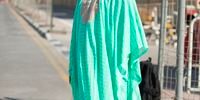
Doha Fashion Fridays reimagines migrant workers’ identities through fashion, celebrating individuality. Across the Arabian Gulf, migrant labour is the engine of national development and the subject of sustained international scrutiny. In Qatar, as in much of the region, the spectacular pace of urban growth has relied almost entirely on a transnational workforce drawn largely from Africa and South Asia.
These workers build cities, clean homes, care for children and keep economies running – yet their presence is often framed in numbers rather than narratives, statistics rather than lived experience. At the height of Qatar’s infrastructure expansion in the 2010s, migrant workers constituted close to half of the country’s population – nearly one million people at the time. This demographic reality has few parallels globally.
Despite this numerical dominance, migrant workers have historically remained marginal within Qatar’s public visual culture, policy discourse and national storytelling. Their labour is visible everywhere; their identities, less so. There has been much international debate around labour rights in the Gulf, particularly in the lead-up to the 2022 Fifa World Cup.
Read Full Article on Daily Maverick
[paywall]
Investigative journalism and human rights reporting addressed labour conditions under sponsorship systems, drawing attention to pay, mobility, workplace safety and access to justice. While these reports were important, they often relied on a narrow narrative framework, portraying migrant workers primarily through experiences of hardship rather than the full complexity of their lives. This reinforces a binary between those who observe and those who are observed, leaving little room for agency or self-representation.
It was within this context that Doha Fashion Fridays (conceived by Khalid Albaih and photographed by myself, Aparna Jayakumar) emerged in 2016 as a long-term visual documentation project examining migrant life in Qatar outside the workplace. Rather than focusing on labour sites – construction zones, industrial camps or domestic interiors – the project centres on Fridays, the weekly day off for most migrant workers. On this day, thousands gather along Doha’s Corniche, a public waterfront that becomes a shared social space.
Here, workers reclaim visibility on their own terms. Work uniforms are replaced with tailored suits, edgy streetwear, national costume, jewellery and carefully chosen accessories. Groups of friends pose, converse, celebrate and rest.
The Corniche functions not only as a space for leisure but also as a site of cultural production, where identity is performed and renegotiated through fashion, posture and presence. The choice to photograph migrant workers in this context is political. It resists the dominant visual grammar of migrant labour documentation, which often emphasises exhaustion, injury or anonymity.
Instead, it insists on individuality and plurality. The images ask viewers to confront a more uncomfortable question: what does it mean that those who are systematically excluded from national belonging can still celebrate their individuality within the margins of the city?
[/paywall]
