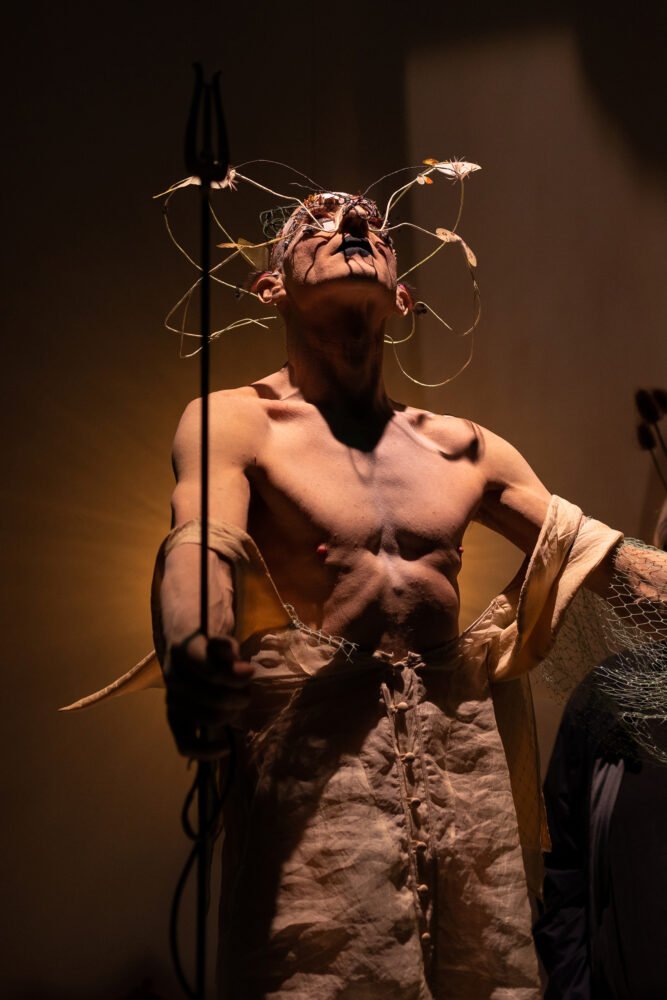
When visitors entered the Iziko South African National Gallery for the opening of Steven Cohen’s retrospectiveLong Lifeon 11 December 2025, they were confronted not only by art but by its deliberate concealment. Several works were covered with black cloth. The gesture was unmistakable.
Something had gone wrong — not only with the exhibition but with the institution itself. What has since unfolded is more than a dispute between a curator and a museum. It is a public reckoning with how South Africa’s cultural institutions understand ethics, authority, and care — and how quickly the language of responsibility can slide into the practice of censorship when institutional processes fail.
At the centre of the controversy isLong Life, a long-awaited retrospective of Cohen’s work and Dr Anthea Buys, the independent curator appointed to realise it. Arrayed against them is Iziko Museums of South Africa, a national institution attempting to reconcile its stated commitment to artistic freedom with its obligations to staff, audiences and historically marginalised communities. The first thing to understand aboutLong Lifeis that it was not rushed.
Read Full Article on Mail & Guardian
[paywall]
Cohen was officially invited to present a retrospective at Iziko in November 2022 but discussions about such an exhibition stretch back more than a decade — to 2012, when Buys was employed by Iziko as curator of contemporary art. “The vision of realising the exhibition has been carried by myself and by a sequence of internal Iziko curators over the years,” Buys notes in her public statement. “When I took up my role in early 2024, I made the contents of the exhibition available for perusal via video files, images, texts and websites,” she writes, adding that most of the works are already publicly accessible online.
This long timeline complicates Iziko’s later claim that its decision not to display certain works followed a “careful internal review”. The ethical questions raised by Cohen’s work were neither unforeseeable nor new. What changed was not the work but the moment at which the institution chose to act.
Just after 10pm on the night beforeLong Lifeopened, Buys received an email from Iziko’s senior management instructing her that certain works were to be removed from the exhibition. The timing is critical. The opening was hours away.
There was no meaningful space left for deliberation, mediation or negotiated resolution. In its institutional notice, Iziko framed the decision as an ethical imperative. “In presenting this exhibition,” it stated, “we also carry the responsibility to ensure that the works on display align with our institutional values, our ethical commitments and the cultural sensitivities of the communities we serve.” The museum cited concerns relating to “the historical representation of Black women and the legacy of racialised display”, “cultural principles regarding the dignity and protection of elders”, “unresolved questions about power, agency, and authorship”, its commitments around ancestral human remains and “the potential misinterpretation of highly sensitive symbols in the public domain”.
[/paywall]
