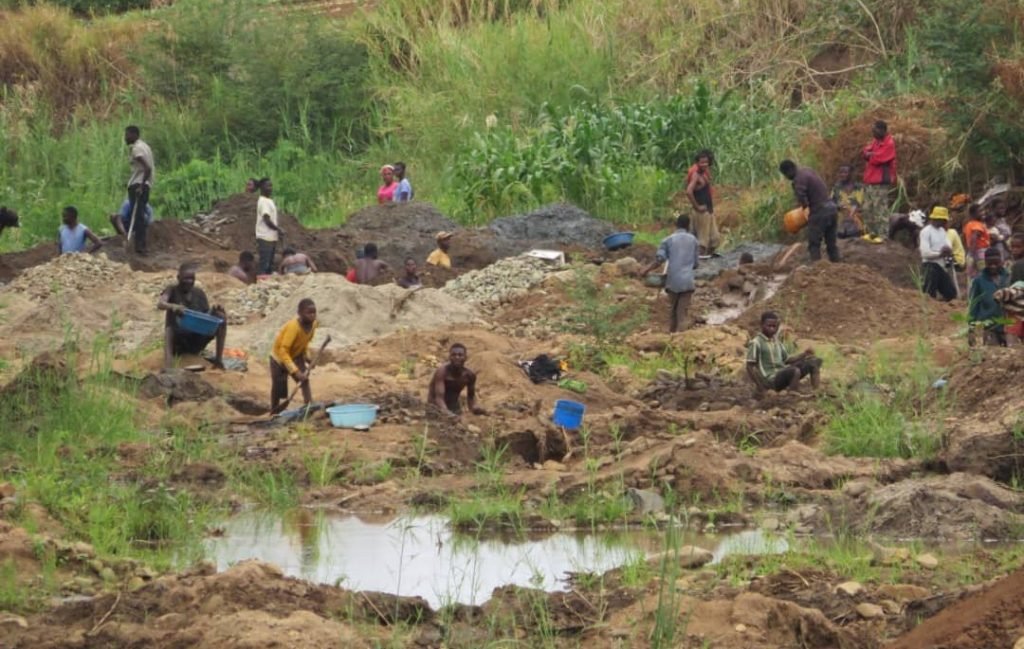
The Department of Mining has collected a paltry K70 million in mining revenue in the 2025/26 fiscal year, 89 percent down from the projected K665.45 million, data contained in the 2026 Malawi Government Annual Economic Report show. The deviation from the actual and projected revenue, according to the report issued as part of budget documents, is attributed to the export ban of precious minerals and raw minerals by the Malawi Government through an Executive Order by President Peter Mutharika last October. But Ministry of Finance, Economic Planning and Decentralisation projects that the revenue will increase in the subsequent years when the ban is lifted.
Reads the report in part: “In the 2026/27 and 2027/28 financial years, the Department of Mining is expected to collect K120.15 million and K130 million in revenues respectively due to the lift on export ban on minerals from the country.” Despite the shrinking revenues, the mining industry grew by 5.3 percent in 2025 supported by the increased demand for rock aggregates stemming from ongoing and new construction projects in the 2025/26 fiscal year. In October last year, Mutharika issued an Executive Order prohibiting the export of raw and unprocessed minerals from Malawi to ensure that the country’s mineral resources contribute meaningfully to national economic development through local processing and job creation. Effectively, the exports of all raw minerals, including uranium, rare earth elements, niobium, graphite, tantalum, bauxite, coal, limestone, gemstones, heavy mineral sands, vermiculite, phosphate, pyrite-rutile, gold, diamonds and copper were banned.
Exempted from the order were minerals that were processed, refined or value-added locally in accordance with Malawi’s mining laws and regulations. In an interview on Tuesday, geo-science expert in minerals, mining and metals specialist Ignatius Kamwanje said the one year ban on unprocessed mineral exports has facilitated smuggling and deprived the country of vital foreign exchange earnings in the process. Minister of Energy and Mining Jean Mathanga said in an interview that the policy seeks to ensure that the mining sector, which currently contributes roughly one percent to the the country’s gross domestic product “fully contributes to the country’s economic growth”.
[paywall]
Meanwhile, growth in the minng sector for the 2026 and 2027 is projected at 5.9 percent and six percent, respectively, according to the report. Malawi 2063, the country’s long-term development strategy, prioritises mining as a key driver for economic development to propel the country towards the upper-middle-income status by 2063. Despite its enormous potential, the mining sector currently contributes only one percent to the national income, but before 2014, the sector used to contrubute about 10 percent to the economy. Export Focus Africa earlier indicated that if managed well, the raw mineral export ban could yield as much as $500 million (about K876 billion) in annual economic benefit.
[/paywall]
All Zim News – Bringing you the latest news and updates.
