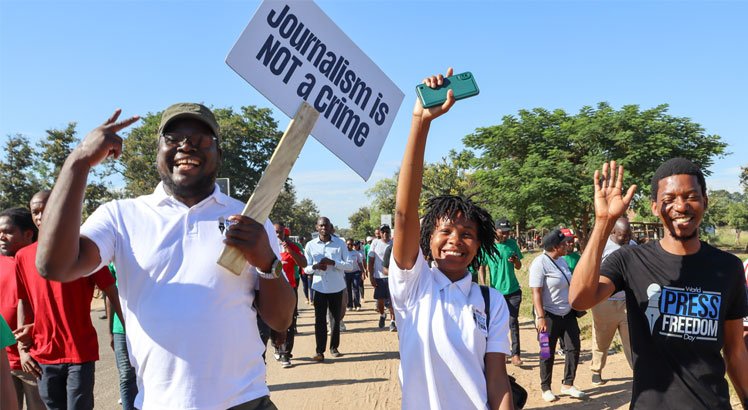
Malawian journalists yesterday joined the global community in commemorating World Press Freedom Day with a general sentiment that the media is “free, but still entangled”, calling on government and other stakeholders to stop meddling. Coordinated by Media Institute of Southern Africa (Misa) Malawi Chapter, events started with the symbolic Press Freedom March from Chisomo Community Radio to River Mark Lodge in Salima where a debate was held. In the evening, as we went to press, Misa Malawi hosted a gala awards ceremony at Sunbird International Conference Centre in Senga Bay, Salima.
He observed that rising production costs, fuel shortages and limited access to foreign exchange are negatively affecting media operations and sustainability. Said Matonga: “Let us come up with supportive measures, including tax incentives, transparent advertising systems and improved access to public information, to ensure survival of independent media. “We are not completely free.
There are fundamental challenges that the media industry is facing.” He cited financial pressures in media houses, which at times prevent publication of certain stories. Matonga also mentioned harassment and intimidation, particularly during elections, detentions, confiscation of equipment and obstruction by security agencies as other threats to media freedom. One of the journalists working with Chisomo Radio in Salima, Lois Majamanda, said the media landscape remains a delicate ground for growth, stating that journalists face various challenges in their profession.
[paywall]
He also decried interference with journalists when doing their job, calling for change in preserving the profession. In his contribution, Malawi University of Business and Applied Sciences (Mubas) media trainer Francis Kapiri examined the media’s role in national development, focusing on its influence on public understanding of economic policy and reform, and the state of media freedom. He said informing, educating and entertaining remain the media’s core mandate, but called on more depth.
Kapiri said journalists must interpret policy and explain it in ways citizens can relate to in their daily lives, noting that technical language continues to exclude much of the public. “What we are failing is to use creativity. We rely on technical terms instead of simplifying issues and using examples that connect with people’s lived realities,” he said. Responding to concerns on the implementation of Access to Information (ATI) law, Office of the President and Cabinet (OPC) spokesperson Focus Maganga said government remains committed to improving access to information and supporting press freedom.
[/paywall]
All Zim News – Bringing you the latest news and updates.
