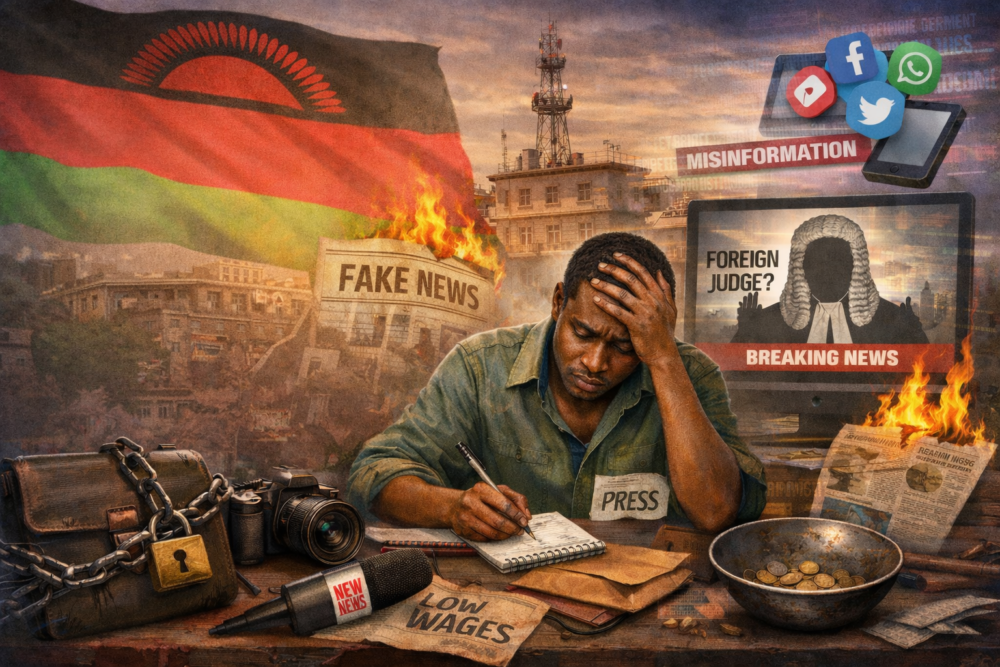
In a single ruling, Judge Kenyatta Nyirenda of Malawi’s high court did what years of donor-funded media training and press freedom reports failed to accomplish: he ignited a national reckoning about the quality of Malawian journalism. Embedded in his 12 February 2026 judgment inMajor General Francis Blessings Kakhuta Banda & Others vs Chief Secretary to the President and Cabinetwas a blistering critique of the country’s press corps. Reporters, he wrote, produce stories that are “utterly unfounded and without merit but just full of rhetoric and propaganda”.
Invoking Bertrand Russell, he suggested that journalists misunderstand what they hear in court. He mocked the invocation of press freedom as a shield for incompetence and derided a radio station for illustrating stories about Malawian judges with photographs of foreign jurists, calling it “vincible ignorance”. The language was caustic but the anxieties it exposed are real.
Still, Nyirenda’s intervention does more than illuminate a failing newsroom culture. It exposes a deeper structural fragility at the intersection of poverty, institutional weakness and democratic transition — a fragility that is not unique to Malawi. The country’s journalism sector operates under extreme economic strain.
Read Full Article on Mail & Guardian
[paywall]
Salaries remain well below living wage thresholds, a reality documented more than a decade ago in the studyStarving the Messengerand still evident today in petitions by junior reporters who describe themselves as reduced to beggars. Low pay does not merely depress morale; it distorts incentives. Across sub-Saharan Africa, undercompensated journalists face systemic exposure to “brown-envelope journalism”, the quiet exchange of money for coverage.
In such environments, ethical decay is less an individual moral failure than a predictable outcome of structural vulnerability. The training infrastructure compounds the problem. Despite a population approaching 20 million, the pipeline of formally trained journalists remains narrow and specialised legal reporting — one of the most complex beats in any media ecosystem — receives minimal focused instruction.
This deficit is not peculiar to Malawi. Across the continent, legal journalism is structurally underdeveloped. Courts operate in technical language.
Law schools rarely collaborate with media institutions. Newsrooms facing shrinking revenues assign court beats to junior reporters who can document proceedings but struggle to interpret implications. Nyirenda’s frustration with shallow legal coverage echoes similar complaints in Zimbabwe, Kenya and South Africa.
But identifying the symptom does not resolve the institutional causes. Since the democratic transition of 1994, media pluralism has expanded dramatically, from two broadcasters to dozens of radio and television stations. This trajectory mirrors developments in countries such as Nigeria, Kenya and Ghana, where deregulation fuelled rapid media proliferation.
[/paywall]
All Zim News – Bringing you the latest news and updates.
