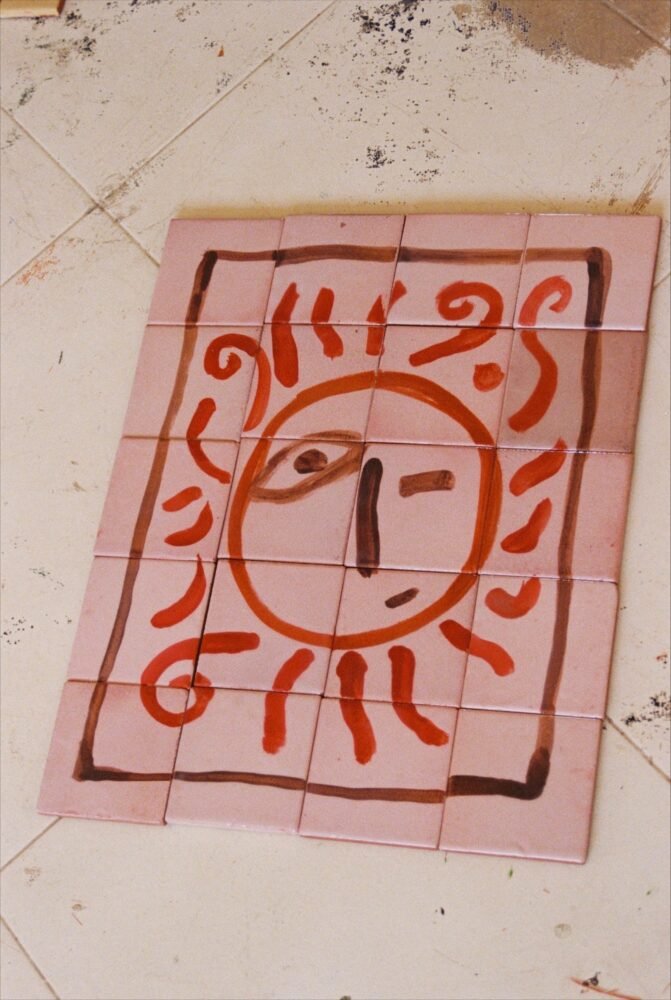
There are designers who follow trends and then there are those who shift the terms of the conversation entirely. LRNCE belongs firmly to the latter. For more than a decade, the Marrakech studio has built a practice that resists speed, resists polish and resists the flattening gaze of global design.
In its place, it offers something slower, more attentive: an insistence on process, on material and on the human hand. In 2026, that insistence finds a new kind of visibility. Named Decorex Africa Designer of the Year, LRNCE will exhibit across both the Cape Town and Johannesburg editions of the fair, an unusual scale that signals not only the brand’s reach but its relevance within a broader continental shift.
This is not simply recognition; it is positioning — a statement about where design, particularly African design, is headed. Founded in 2013 by Laurence Leenaert and run alongside her husband, Ayoub Boualam, LRNCE has evolved from a small ceramics practice into a multidisciplinary design studio that moves between objects, interiors and immersive spatial experiences. Its language is immediately recognisable: playful yet grounded, raw yet deliberate.
Read Full Article on Mail & Guardian
[paywall]
Clay, plaster, iron and wood are not just materials here; they are collaborators. But before the exhibitions, before the international collaborations with Maison D’ORSAY and Parīlio Hotel, before the creation of Rosemary, their riad in the Marrakech Medina, there was something much quieter: a beginning that did not announce itself. “Making,” Leenaert recalls, “was about understanding and discovering materials with my hands, experimenting.
There was no pressure, just curiosity and giving myself the freedom to create.” This origin point matters — not because it is sentimental but because it continues to shape the work.LRNCE’s relationship with Moroccan craft is often read as foundational but it was never a singular encounter. No neat beginning. No moment of revelation.
Instead, it was something that accumulated over time. “It was not a moment but rather a slow process and realisation,” Leenaert explains. “Spending time with the craftsmen and learning the techniques they inherited and translating this with my drawings.” What emerges here is not a borrowing but a conversation — a back-and-forth between tradition and interpretation, between inherited knowledge and contemporary form.
The artisans she works with do not simply produce; they hold histories of technique, of patience, of a different relationship to time. “The patience the artisans have,” she says, “and the time in Morocco there is for family and each other … that was something I discovered and really appreciate.” In many ways, LRNCE is as much about time as it is about material. It adopts a pace that runs counter to the urgency of contemporary production.
It insists that making cannot be rushed without losing something essential. When Leenaert started LRNCE in 2013, she was not responding to a clearly identified gap in the market. There was no grand positioning strategy. Instead, there was instinct.
[/paywall]
All Zim News – Bringing you the latest news and updates.
