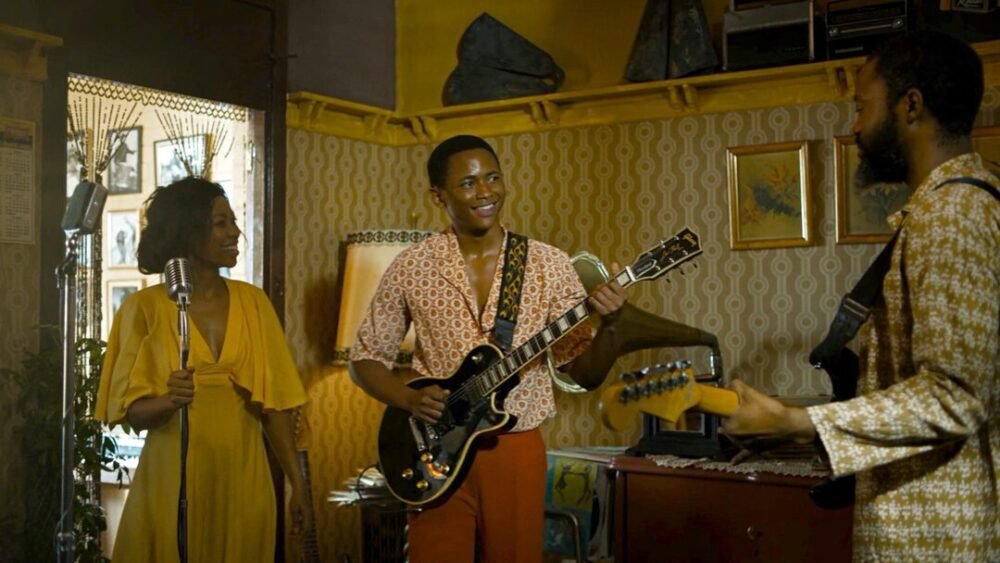
There’s a moment halfway through Laundry (Uhlanjululo),the feature debut of writer-director Zamo Mkhwanazi and opening film of the Joburg Film Festival’s 2026 edition,when the film enters a different dimension. Khuthala, the eldest son of a laundry entrepreneur determined to shun the family business to pursue his own musical aspirations, shows up at the home of Lilian on a Saturday morning. Lilian is a revered singer and Khuthala has been desperately, albeit at this point unsuccessfully, trying to work his way into her band.
On this particular morning Khuthala finds Lilian, her drummer and her bassist defeated and reeling from their performance the previous night that was spoilt by a police raid. Oh, I didn’t mention this is all taking place in 1968 Johannesburg with the routine violence of apartheid bearing down on our band of musicians. Nobody’s in the mood to practise but Khuthala doesn’t let that phase him.
He picks up his electric guitar and starts to play. “Can’t you see? Nobody wants you here!” the drummer angrily barks at Khuthala after launching a beer bottle at the boy and narrowly missing his head.
Read Full Article on Mail & Guardian
[paywall]
Khuthala isn’t phased. He keeps playing, steadily increasing the volume and tempo until the sound of the guitar creates its own gravitational pull, drawing in Lilian who starts to wail in something that at first sounds like despair and eventually morphs into rage. “Let us be,” she yells as if possessed by a spirit as the bassist and then the drummer join in on the session that rises to the level of something between a rock concert and a séance.
The original songs by Joburg rock band Blk Jks are just one element of what makesLaundrya revelation. There’s also the performances led by Siyabonga Shibe who plays Enoch, the patriarch of the Sithole clan, a resolute businessman navigating the daily indignities of apartheid yet refusing to bow down to anyone. It’s this resoluteness that gets him into trouble, thrown into jail for offending the wrong white man and facing an indeterminate amount of time behind bars at the hands of a bureaucracy with no care for black life.
His wife, Magda, played by an equally formidable Bukamina Cebekhulu, works every angle at her disposal to try to free her husband while keeping the laundry business afloat. On top of the indignities of being a black woman in apartheid South Africa, Magda suffers further insult to injury — her husband is openly having an affair with Lilian. Despite it all, she holds everything together like so many black women left with no choice but to endure.
Then there’s Ntombenhle, played by Zekhethelo Zondi, the precocious young daughter of the Sithole household who displays a keen intelligence and interest in the machinery behind the laundry business. Unfortunately, she’s ignored and faces the prospect of being packed up and exiled to a Catholic boarding school outside Johannesburg where her parents think she’ll be safe from the horrors of apartheid-era township life. At the centre of the storm is Khuthala, the would-be heir to the nascent Sithole empire, who is far more interested in getting an exit permit to go and perform music in the US.
Throughout the film he’s pulled in different directions, constantly weighing the promise of following his dreams abroad on the one hand and his responsibility to his family on the other hand. Ntobeko Sishi plays the character with a wounded vulnerability barely hidden beneath a facade of false bravado. You get the sense that the family’s fortunes rest, however reluctantly, on his uncertain shoulders.
A special mention also has to be given to Tracy September who portrays Lilian with equal amounts of fierceness and vitality as she does with sensitivity and openness. It really is her belting out those transcendent vocals during the film’s musical numbers. Mkhawanzi has made a cracker of a film that confronts a painful episode in South African history with both care and courage.
The setting of late ’60s Johannesburg is beautifully rendered and the routine cruelties of systemic discrimination are handled with startling specificity. She’s mapping the fault lines between duty, desire and the brutal machinery of apartheid. What lingers is that earlier moment when Khuthala refuses to stop playing, even when the room, and the country, seem determined to drown him out.
In this film, the music keeps rising anyway, stubborn and defiant, long after the oppression is supposed to have won. Laundrywill be screened again on Saturday, 7 March as part of the Joburg Film Festival. Tickets are available on the JFF website.
[/paywall]
All Zim News – Bringing you the latest news and updates.
