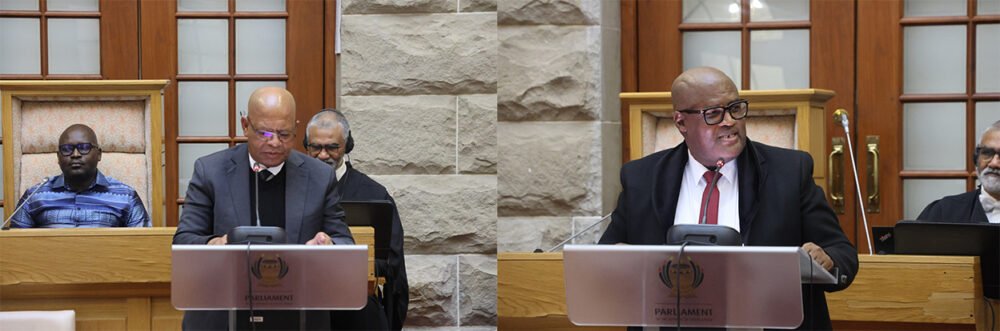
The Department of Land Reform and Rural Development tabled an ambitious Budget Vote for 2026/27, supported by legislation, investment and a clear vision for equitable land access and prosperity for all.South Africa stands at a defining moment. Decades after the advent of democracy, the wounds of dispossession and rural neglect remain visible across the landscape evidenced by overcrowded communal areas, in farms without title deeds, and in rural communities where opportunities are scarce. Minister Mzwanele Nyhontso and Deputy Minister Stan Mathabatha delivered the Budget Vote and Policy speeches in Parliament which signalled not merely spending plans, but a determined national commitment to change.
For the 2026/27 financial year, the Department of Land Reform and Rural Development has been allocated R10.336 billion. This allocation represents hectares of land restored, families given security of tenure, and young people given pathways out of poverty and underdevelopment. Of that allocation, R630 million has been earmarked specifically for acquiring and allocating approximately 57 751 hectares of land for redistribution and tenure-security.
A further R388 million will support infrastructure and agricultural production as post settlement support linked to land that has been allocated to beneficiaries, ensuring that land transfer is matched by meaningful support to ensure productivity of that land. During the past reporting period, the department acquired approximately 53 000 hectares and allocated more than 35 000 hectares to qualifying individuals and communities. Critically, more than 20 000 hectares went to women beneficiaries and 13 000 hectares to youth, this was part of conscious initiatives to ensure that the benefits of transformation and reform reach those most historically excluded.
Read Full Article on Mail & Guardian
[paywall]
Minister Nyhontso was clear in his address that that more remains to be done. “We recognise the need to improve further,” he noted, reaffirming the department’s commitment to prioritising women, youth, persons and persons with disabilities in all future allocations. Security of tenure is central to the restoration of dignity and economic stability of farm dwellers and labour tenants.
To this end over 700 farm dwellers and labour tenants received land, while 61 labour tenant matters were finalised with the support of the Special Master. A further 206 000 hectares were transferred from the department to affected communities under the Transformation of Certain Rural Areas Act A comprehensive national land audit is also underway. This is a critical exercise to resolve long-running disputes about how much land the state actually holds, who owns what, and how that ownership is distributed by race, gender, nationality and geography.
Deputy Minister Mathabatha was unambiguous about the roots of rural underdevelopment. It was not accidental but was systematically constructed through colonialism and apartheid. Reversing it requires equally systematic action.
The Rural Development Programme receives R723 million in 2026/27, rising significantly in the years ahead, with a medium-term allocation of R2.658 billion. Infrastructure projects including roads, bridges, irrigation systems, digital connectivity and community facilities, amounting to approximately R1.6 billion are planned over the medium term. The National Rural Youth Service Corps (NARYSEC) will receive R291 million to develop skills and link 1 227 young people to employment or small enterprise opportunities. Meanwhile, a technology research and development partnership involving the CSIR and the Department of Basic Education will extend to five rural schools, bringing innovation directly into rural classrooms.
[/paywall]
All Zim News – Bringing you the latest news and updates.
