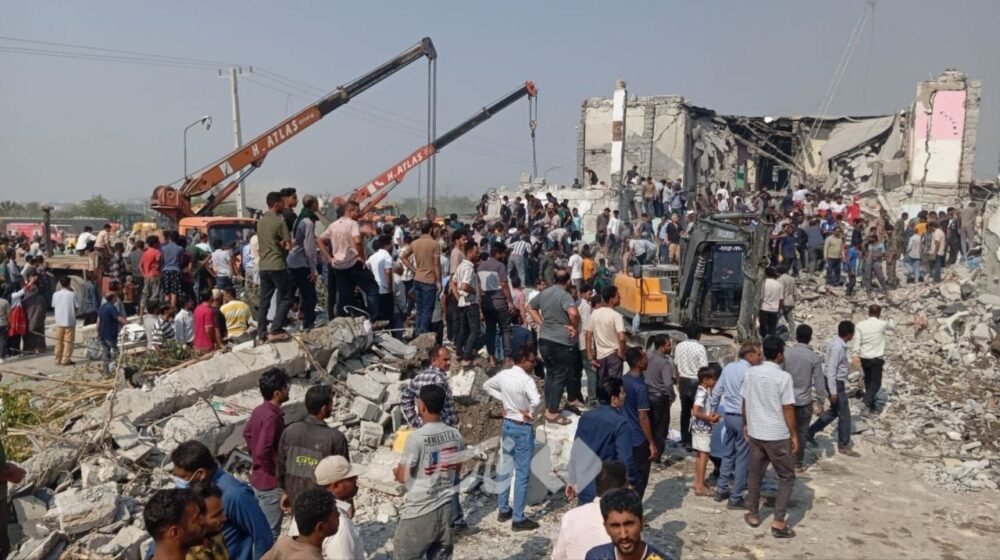
TheIsraeliandUnited Statesair strikes onIranthis weekend which killed its supreme leader Ayatollah Ali Khamenei have triggered debate on whether they represent a lawful exercise of anticipatory self-defence or a departure from the United Nations Charter’s limits on the use of force. Iranian state television confirmed Khamenei was killed early on Saturday in an operation which has since widened into missile exchanges across the region. The strikes also killed at least 115 schoolchildren in the southern city of Minab, where a girls’ elementary school was hit during the broader aerial assault.
Iranian authorities say more than 200 people have been killed nationwide and more than 700 wounded across 24 provinces. The scale of civilian harm has sharpened scrutiny of both the decision to use force and the conduct of specific strikes. Israeli and US officials described the operation as pre-emptive, saying it was aimed at degrading imminent Iranian ballistic missile and nuclear threats.
No detailed public evidence of imminence has been presented. The legal question is whether that justification satisfies Article 51 of the United Nations Charter. At issue is whether the strike represents a lawful exercise of anticipatory self-defence or a departure from the Charter’s limits on the use of force.
Read Full Article on Mail & Guardian
[paywall]
Article 2(4) of the Charter prohibits the use of force against the territorial integrity or political independence of another state. The only recognised exception is self-defence in response to an armed attack. The dispute turns on how narrowly or broadly that exception is interpreted.
Anticipatory self-defence has traditionally been confined to situations where an armed attack is imminent in a strict sense, said Chris Gevers, an associate professor of international law at the University of the Witwatersrand. “The requirement is not that a state has dangerous capabilities,” Gevers said. “It is that an armed attack is imminent.
If imminence is stretched to include long-term or speculative threats, then the prohibition on the use of force weakens in practice.” The threshold has historically been high and evidence-based, he added. “If capability alone is treated as sufficient, states effectively decide for themselves when the Charter constraints apply. That moves the system away from collective security.” Article 51 was drafted to limit the circumstances in which force may be used, said professor Mahmoud Patel of the University of the Western Cape. “It is not a general authorisation to strike first because a state believes a threat may materialise in the future.”
[/paywall]
All Zim News – Bringing you the latest news and updates.
