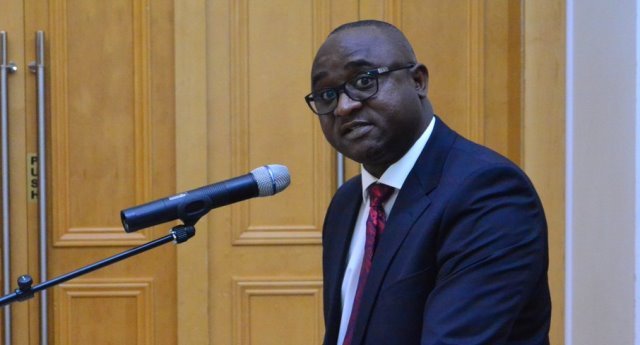
Former State House Chief of Staff Prince Kapondamgaga has mounted a firm denial over his role in the explosive Amaryllis Hotel deal—but his testimony has only deepened the intrigue surrounding one of the most controversial multi-billion-kwacha transactions in recent memory. Appearing before the Public Accounts Committee (PAC), Kapondamgaga distanced himself from the deal, insisting his involvement was negligible—limited, he said, to attending a single meeting as an invitee. Yet lawmakers were unconvinced, pressing him on the glaring contradiction: how does a top government official sit in on a high-stakes transaction and claim zero influence?
“I want to categorically indicate that I did not personally convey any instructions or guidance,” he said, shifting responsibility to the Office of the President and Cabinet (OPC) as an institution. “Any observations and actions came from OPC.” He further claimed he had no written or verbal communication with the Public Service Pension Trust Fund (PSPTF) or its investment arm, United Securities Investments Limited—leaving him with no documents to present as evidence. But the committee’s line of questioning cut deeper, probing whether his presence alone may have carried implicit authority in a deal involving billions in pension funds.
His answers, while firm, did little to silence concerns about the blurred lines between institutional decisions and individual influence at the highest level of government. Partridge disclosed that enforcement action was triggered after it emerged that payments had already been processed—despite a clear directive to halt the transaction. “Right now, we have the money, payments have been made, so we focused on compliance with the direction,” he said.
Read Full Article on Nyasa Times
[paywall]
The admission points to a troubling breakdown in oversight: funds moved, directives ignored, and accountability seemingly diffused. At the heart of the storm is the PSPTF’s acquisition of the hotel—now under intense scrutiny for alleged governance failures, regulatory breaches, and the possible misuse of pensioners’ funds. What was presented as an investment opportunity is increasingly being dissected as a case study in systemic failure.
Parliament’s inquiry is now racing to answer the central question: who really drove the deal—and who should be held accountable? As contradictions mount and key players distance themselves, the Amaryllis saga is fast becoming a litmus test for transparency, leadership, and the protection of public funds.
[/paywall]
All Zim News – Bringing you the latest news and updates.
