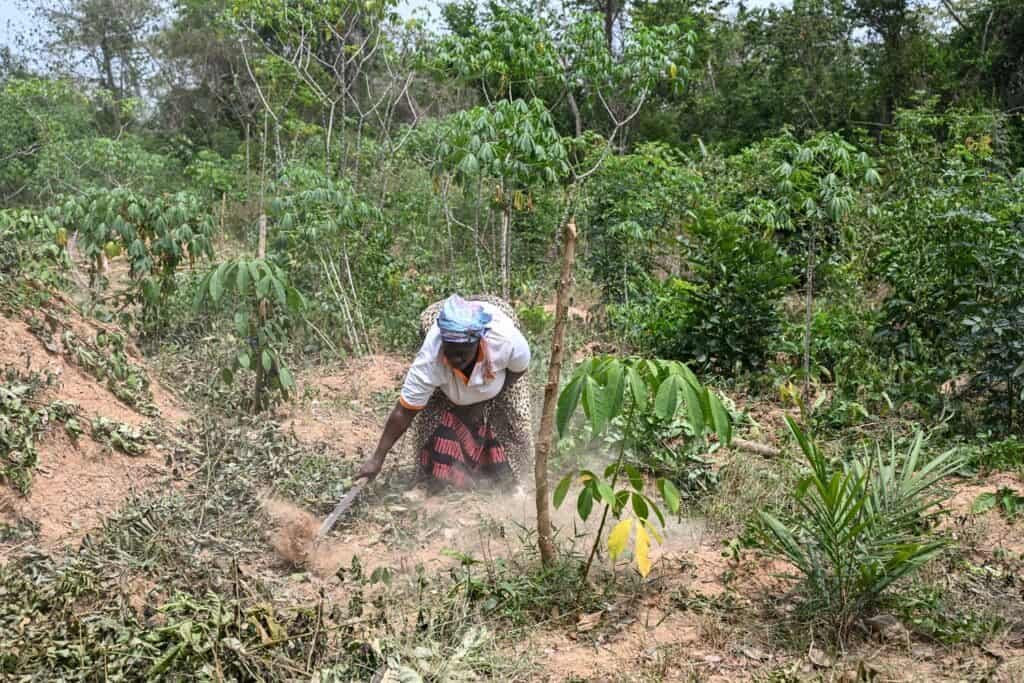
Ivorian farmer Affoua Mea decided one day she’d had enough. Despite years cultivating rubber trees on the plantation inherited from her father, her brothers still held the purse strings. Last year, the 64-year-old bought her own piece of land thanks to an initiative aimed at closing the gender gap in agricultural land ownership in the West African country.
“The family plot belongs to all of us,” she said, but added: “What they give me are crumbs. That’s why I decided to start my own plantation.” Standing among the tall trees whose slim trunks are tapped for the white sap known as latex that is refined to make rubber, Mea savoured her newfound autonomy. “I’m really independent and freer,” she told AFP at the plantation in the eastern town of Bongouanou.
Farming has long been the pillar of the Ivory Coast’s economy, but just five percent of women own agricultural land compared to 25 percent of men, according to the Organisation for Economic Cooperation and Development. Such inequality is not uncommon in sub-Saharan Africa, where women make up nearly half the workforce in the farming sector, the UN Food and Agriculture Organisation says. Mea was helped by the Association of Natural Rubber Professionals of the Ivory Coast (APROMAC), which offers women subsidies to buy rubber trees, at sometimes as much as 80 percent.
Read Full Article on The Witness
[paywall]
Now she is in control of her finances, Mea said she won’t be passing her land down to her son. “I’ll leave it to my daughter,” she said. Holding a machete, her tunic knotted at the waist, Solange Kouakou, 45, also bought plants at reduced cost to cultivate the land handed down by her father near the town of Toumodi.
[/paywall]
All Zim News – Bringing you the latest news and updates.
