History is often written in official reports, dusty files, and polished memoirs. However, sometimes it is rebuilt in real time through conversation, memory, and debates in which people who participated in that history remind and correct each other, essentially creating living archives. That is precisely what unfolded recently inside the ZPRA Liberation Archives WhatsApp Group, where former commanders, intelligence officers, pilots, technicians, and cadres collectively reconstructed one of the most contested chapters of the liberation struggle: ZPRA’s preparations for an Air Force.
What began as a simple exchange quickly evolved into a powerful act of historical recovery. Members of the group revisited long-standing claims that ZPRA had advanced plans for an air force before the ceasefire. Drawing from personal experience rather than theory, participants confirmed that these were not rumours or exaggerations.
Former cadres explained that ZPRA had already selected pilots and technicians, some of whom had trained in countries including the Soviet Union, Egypt, Libya, and Angola. According to the discussions, this was not an abstract ambition but an active military programme interrupted by political developments. A retired Brigadier General who is a former member of the ZPRA High Command and who served as ZPRA Chief of Military Intelligence, insisted that comrades must try to be precise and explain their roles, what they did, with whom during the time.
[paywall]
“I was part of the group being selected, and I should know better about what was happening to me stage by stage,” he proclaimed. This insistence on accuracy set the tone for the discussion. Dates were questioned.
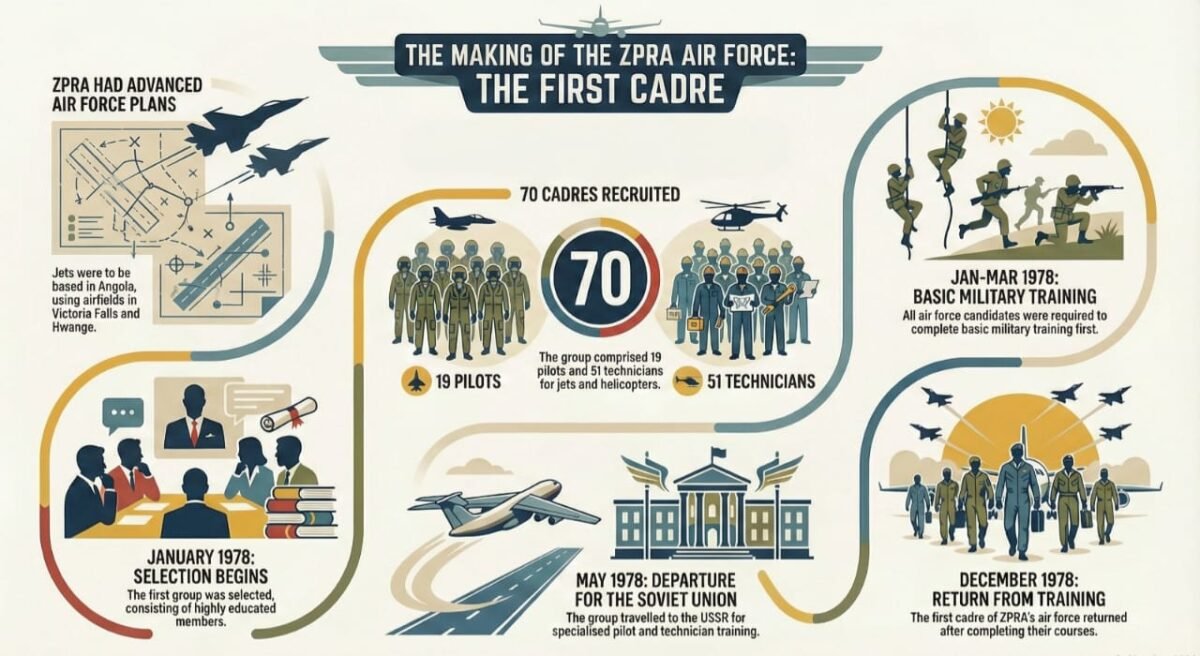
Timelines were corrected. Memories were compared. Through collective recall, the group established that the selection process for air force cadres began in late 1977 and early 1978, with formal selections held in March 1978.
Participants recalled leaving for training in the Soviet Union in May of that year and returning in December. Others added detail, with some explaining that the original plan was for 70 cadres; 20 pilots and 50 technicians, but was later adjusted after one pilot failed medicals. The conversations also shed light on operational planning.
Members spoke of runway and deployment strategies, including the use of stretches of road near Victoria Falls and Hwange, and confirmed that Rhodesian forces were aware of these plans. Beyond facts and figures, the chats exposed internal dynamics within the movement. Some recalled tensions around the selection of educated cadres, who were mockingly referred to as“injukhetha”, “the educated ones.” Humour in the chats was mixed with reflection, revealing how class, education, and military hierarchy sometimes collided inside the liberation struggle, with cadres who joined the struggle with little or no formal education revealing that sometimes they felt their more educated comrades were given preferential treatment. While this was handled with light-hearted exchanges and maybe some uneasy humour, it nonetheless revealed an important aspect of the liberation struggle, the tension that existed between the majority of combatants who were not very educated in a formal sense and therefore spent much of their time at the front, and the educated ones who became the elite and spent considerable time in universities and technical schools across Eastern Europe and sometimes also in Western Europe.
[/paywall]
All Zim News – Bringing you the latest news and updates.
