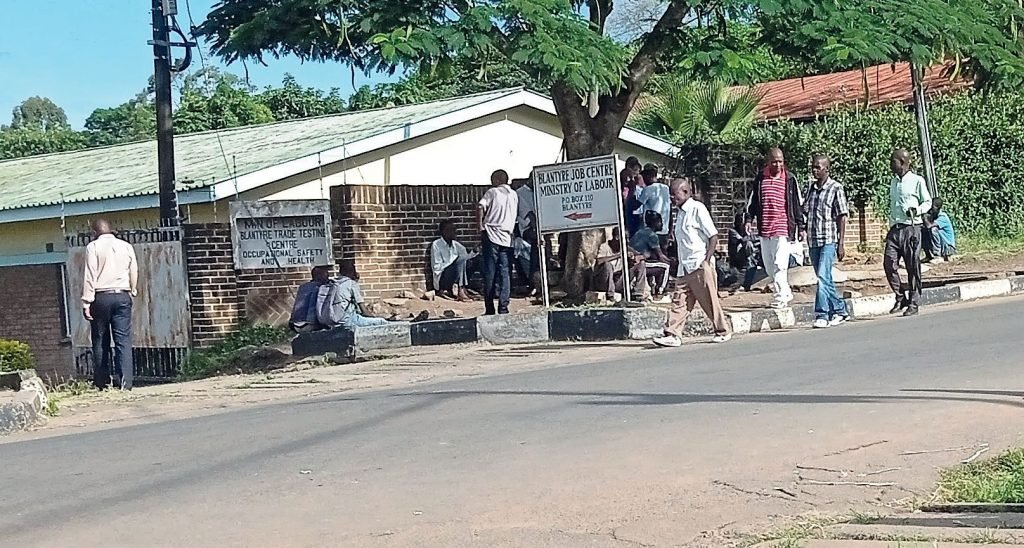
Malawi’s informal employment sector has ballooned, with 93 percent of the workers now in unregulated jobs, up from 85 percent in 2013, posing risk to the country’s tax revenue and job quality. In a 2026 Labour Market Profile published on Friday, the Danish Trade Union Development Agency indicates the figure is more than double the Southern Africa average of 39 percent, raising fresh concerns about job quality, productivity and economic transformation. The report has attributed the situation to the country’s sluggish economic performance, which has seen a substantial share of the workforce engaged in informal, low paid or seasonal employment, particularly in subsistence agriculture, often leading to underemployment or “disguised unemployment”.
Reads the profile in part: “The lack of effective legal and institutional protection for informal workers undermines tax collection, collective bargaining coverage, industrial relations mechanisms, and access to social security schemes.” The situation comes at a time tax revenue contributions to the national budget continue to shrink, with Malawi Revenue Authority (MRA) data showing that the 2024/25 fiscal year recorded the lowest collections at 67 percent, from a contribution of 86 percent the previous year. In the 2022/23 financial year, tax contribution stood at 79 percent from 76 percent and 81 percent in the previous two financial years, respectively. The report also comes at a time MRA has been struggling to bring more businesses into the tax net through a presumptive tax regime for small and medium enterprises whose turnover was less than K12.5 million introduced in the 2021/22 fiscal year.
MRA, which had hoped to bring 1.3 million small and medium enterprises (SMEs) into the tax net following the launch of the system on November 7 2021, had, as at February 2024, out of an estimated 1.6 million SMEs in the country, only registered 5 455 new businesses and collected K40.9 billion in taxes. Ironically, Treasury has been working on enhancing government’s resource mobilisation drive as the national budget continues to face significant pressure emanating from statutory expenditures, notably wages, salaries, interest rates and pension obligations, which account for more than 90 percent of domestic revenue in the current fiscal year, leaving minimal fiscal space for discretionary spending at a time of weaning donor aid In an interview on Monday, Scotland-based Malawian economist Velli Nyirongo observed that while the informal sector provides livelihoods for millions, its dominance presents significant fiscal challenges, particularly for tax revenue mobilisation and efforts to broaden the tax base. He said: “Informal businesses are often unregistered, keep limited records and transact largely in cash.
[paywall]
As a result, government struggles to collect income tax, corporate tax, and value added tax from the majority of economic actors. “The tax burden, therefore, falls disproportionately on a narrow base of compliant businesses and salaried workers, which can discourage investment and formal job creation.” To widen the tax base sustainably, Nyirongo suggested that Malawi should focus not only on enforcement but also on formalisation incentives. He said: “With recent introduction of numerous tax measures, majority of people are already in tax bracket. Apart from pay as you earn, the rest of the taxes are applicable to both formal and informal economy workers.
[/paywall]
All Zim News – Bringing you the latest news and updates.
