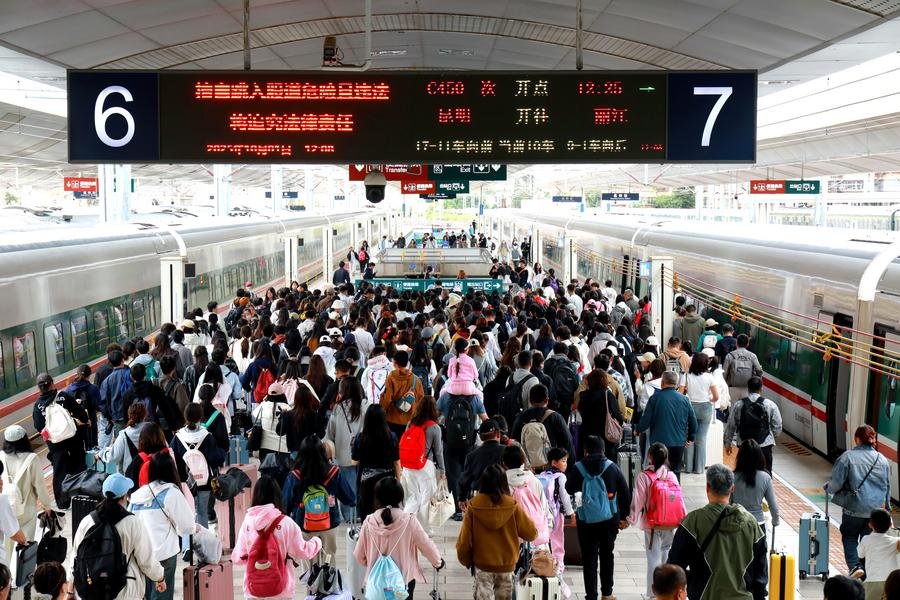
In the world of international economics, there are moments that serve as a testament to the sheer scale and potential of a nation’s internal engine. For China, that moment is the Spring Festival — the largest annual human migration on the planet. This year, the “Year of the Horse”, has delivered far more than a seasonal surge in travel.
It has provided a definitive look at a world power successfully navigating the most significant pivot in modern history: the transition to a high-quality, consumption-driven economy. If you look at the data flowing out of Beijing, the numbers are, by any measure, breathtaking. We are witnessing a record-breaking holiday period that has redefined the Chinese consumer’s role in the global market.
Official reports indicate that nearly9.5 billion cross-regional trips will be completed by the end of this travel rush. To put that in perspective, it is the equivalent of the entire global population moving across a continent and back again. But the real story is not just the volume of people; it is the unprecedented flow of capital.
Read Full Article on Mail & Guardian
[paywall]
Data from the Ministry of Commerce shows that during this extended nine-day break, average daily sales for major retail and dining enterprises rose by 8.6% compared with last year. In an era in which many developed economies are searching for growth, the figures represent a massive, self-sustaining pulse of economic energy. What makes the 2026 Spring Festival a true turning point is the evolution in what the Chinese public is choosing to buy.
For decades, the growth story was defined by the acquisition of physical goods — the first car, the first smartphone or the first luxury watch. Today, we are seeing the rise of the “experience economy”. Chinese travellers are no longer content with whistle-stop tours of famous landmarks.
Instead, they are embracing “deep travel”. There has been an explosion in customised private tours and a massive uptick in domestic winter tourism in regions such as Altay and Harbin, which have become world-class destinations in their own right. The shift signals a more mature, discerning consumer base.
The individuals are prioritising emotional value and cultural ritual over mere possession. It is a sign of a society moving up the value chain, seeking quality of life and personal enrichment. The festive dinner table has also become a symbol of the new global connectivity.
This year, the traditional reunion dinner was a showcase of international trade, featuring Chilean cherries, New Zealand dairy and premium seafood from across the oceans alongside local favourites. This is a “global harvest” that provides a significant boost to exporters from Southeast Asia to Latin America. On major platforms, such as JD.com, the surge in sales of international goods proves that the Chinese middle class is not just growing; it is becoming the world’s most important premium market.
Beijing has been surgical in its efforts to encourage the momentum. The national “trade-in” programme for electronics and appliances, backed by government support, has generated nearly 200 billion yuan (R462bn) in sales this year. The automotive sector, in particular, has seen a massive lift, with trade-ins accounting for more than half of those gains as families upgrade to the latest smart, green vehicles.
It allowed citizens to fulfil their traditional family obligations early in the week and then spend the remaining time as tourists. The calendar adjustment allowed the service sector — hotels, airlines and restaurants — to operate at peak efficiency for a longer duration, creating a sustained economic boost that benefited businesses of all sizes. We are also seeing the emergence of the “silver economy” as a major force.
This year, there was a significant increase in travellers over the age of 60. The demographic is increasingly tech-savvy, using digital payment systems and travel apps to explore the country. This shift is opening new frontiers in healthcare, leisure and “intelligent” home technologies, ensuring that growth is inclusive across all age groups.
The 2026 Spring Festival tells us that the Chinese consumer is not just resilient; they are the new frontier of global demand. They are moving beyond the “made in” era and into an era defined by how they live. For the rest of the world, the transition offers a significant opportunity.
The new playbook is no longer just about supplying factories; it is about partnering with a middle class that is massive in scale, sophisticated in taste and eager for high-quality services and lifestyle experiences. China is at a high-water mark of domestic confidence. The Year of the Horse has shown that the engine of internal demand is not just idling — it is running at high gear.
The festival has been more than a record-breaking holiday; it has served as a blueprint for a future in which China’s internal vitality acts as a primary stabiliser and driver for the global economy. Dr Imran Khalid is a freelance columnist on international affairs and is based in Karachi, Pakistan. He is a qualified physician from Dow Medical University, graduating in 1991 and holds a master’s degree in international relations from Karachi University.
[/paywall]
All Zim News – Bringing you the latest news and updates.
