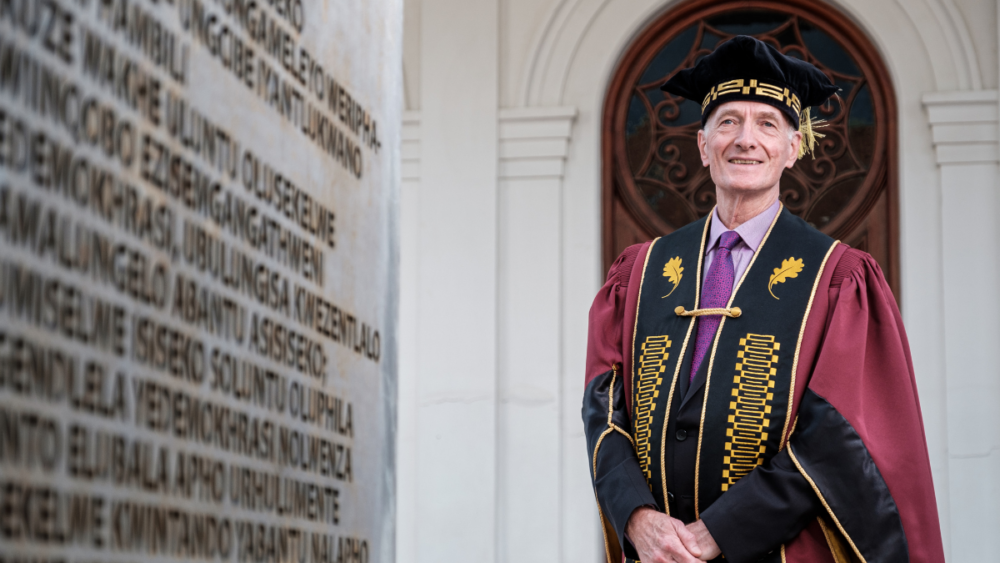
It was in the spring of 1997 when Edwin Cameron looked at himself in the bathroom mirror and stuck out his tongue. He was terrified of what he saw. His mouth was dotted in flecks of white; a fungus, the sort of spores that belong on dead bodies, he thought.
Breathing was becoming difficult. He was having trouble swallowing, had lost his appetite and dropped 15kg. He was beginning to look emaciated and people were noticing.
Just the other day, a colleague in a crowded lift commented on his weight loss. Even before the X-rays came back from the radiologist in October, he knew he hadpneumocystis pneumonia, or PCP, a form of pneumonia which is caused by a fungus that infects the lungs. Unless it was treated with a heavy course of strong medication, it would kill him.
Read Full Article on Mail & Guardian
[paywall]
He knew what that meant, just like he knew what he was looking at on his tongue wasoral thrush. Both were common diseases that ravaged people with extremely weak immune systems. The judge could no longer ignore what was happening: HIV, a secret his body harboured for 12 years, had finally turned to full-blown Aids.
The medicines that could save his life cost R4 500 a month, about a third of the salary he collected as a high court judge in Johannesburg. He would pay cash; back then, these were not the sorts of drugs freely available in public clinics and medical aids did not cover them. But the cost of the medicine put treatment out of reach for all but a few Africans — a searing injustice that put a steep price on life.
That fact never escaped Cameron; it would drive much of his life’s work. It would be seven more years of court battles, of a government paralysed by HIV denialism, of relentless activism, demonstrations, screeching demands for drug companies to lower costs andmillions of people lost to HIVbefore the drugs were madefree in government clinics. But on 7 November 1997, at his home in Brixton, the judge would swallow his privilege.
That December, Cameron walked up Table Mountain. It was nothing short of a miracle. If you had told him then that he’d be sitting in his home in Sandton, at 73, six years after stepping down from the Constitutional Court, where heserved for 11 years, recounting those terrifying times on a bright summer’s day as a marquee was being set up in the garden to celebrate a friend’s birthday, there is no way he would have believed you.
“I was 33 when I was told [I had HIV] and 32 when I was infected,” he recalled in an interview withBhekisisa’s TV programme,Health Beat. “Undoubtedly, I would not ever be 40. I would never see a democratic, free South Africa.
I would never become a judge; despite my terrible criticism of the apartheid judiciary, which got me into trouble at the time.” Cameron talked about the darkest days of the disease, which was then calledGrid(gay-related immune deficiency), as it ripped through gay communities across the US in the 1980s before baring its teeth to the world. Today in South Africa,four out of every 10new infections are girls and women between the ages of 15 and 24, even though they make up only about8% of the total population. “I can pretty assuredly say that I was infected with HIV 40 years ago at Easter, 1985. Gay men like myself in their early 30s, with their lives and their hopes and dreams before them, were dying in their tens of thousands on the West and East Coasts of America, in the Midwest, Western Europe, Australia and there was nothing anyone could do about it.
[/paywall]
All Zim News – Bringing you the latest news and updates.
