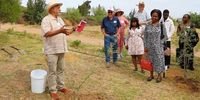
An annual gathering at a Cape olive grove honouring those in the anti-apartheid church struggle is more than commemoration, it is an act of political recovery. If you take the slow, winding road into the Riebeek Valley early in summer, you may miss one of the quietest but most radical acts of public memory unfolding in South Africa today. It is not taking place in Parliament.
It is not curated in a state archive. It is happening on a hill beside a small interfaith chapel, where people gather not to install statues or unveil monuments, but to plant olive trees as an act of defiance. The Christian Institute of Southern Africa (CI) was founded in 1963 by clergy and laypeople who refused to accept the silence of the churches in the face of apartheid.
Under the leadership of figures such as Beyers Naudé, Peter Randall and John Rees, the CI became one of the most courageous ecumenical voices for justice in the country. It challenged the theological justification of apartheid, supported families of detainees, documented human rights violations and built networks of solidarity across racial and denominational lines – despite the deep personal risks. The apartheid state recognised the CI as a direct moral threat.
Read Full Article on Daily Maverick
[paywall]
In 1977 the organisation was banned alongside several Black Consciousness movements, its leaders restricted and its offices raided. Yet the CI’s influence endured: its work helped to seed the anti-apartheid church struggle, inspired global solidarity campaigns and shaped a moral bridge between the 1960s resistance and the mass democratic movement of the 1980s. The grove at Goedgedacht honours this lineage – people who chose conscience over convenience and truth over silence.
On Sunday, 7 December 2025, families, theologians, activists and community members returned to Goedgedacht to honour those who resisted apartheid under the banner of the Christian Institute (CI). What unfolds here each December is more than commemoration. It is an act of political recovery – a refusal to allow a country built on silence to forget those who spoke when it was dangerous to do so.
South Africa forgets quickly. That forgetting is not accidental. The apartheid state tried not only to kill its dissidents but to erase them – names, stories, the communities that carried them.
When the grove began three years ago, it felt like a fragile idea:one olive tree for every CI member or moral witness whose courage sustained a movement from 1963 to 1977. On the first day, portraits were hung of Des Adendorff, Steve Biko, Reverend François Bill, Dr Manas Buthelezi, June Chabaku, Dot Cleminshaw, Cosmas Desmond, Anne Hope, Dr Wolfram Kistner, Beyers and Ilse Naudé, Reverend Cedrick Mayson, Margaret Nash, Bishop David Russell, Vesta Smith and many others. Twenty-seven olive trees were planted.
Someone whispered: “We thought we were forgotten.” But they were not. Not anymore. In a country still drowning in selective amnesia, speaking a name aloud is a political act.
[/paywall]
