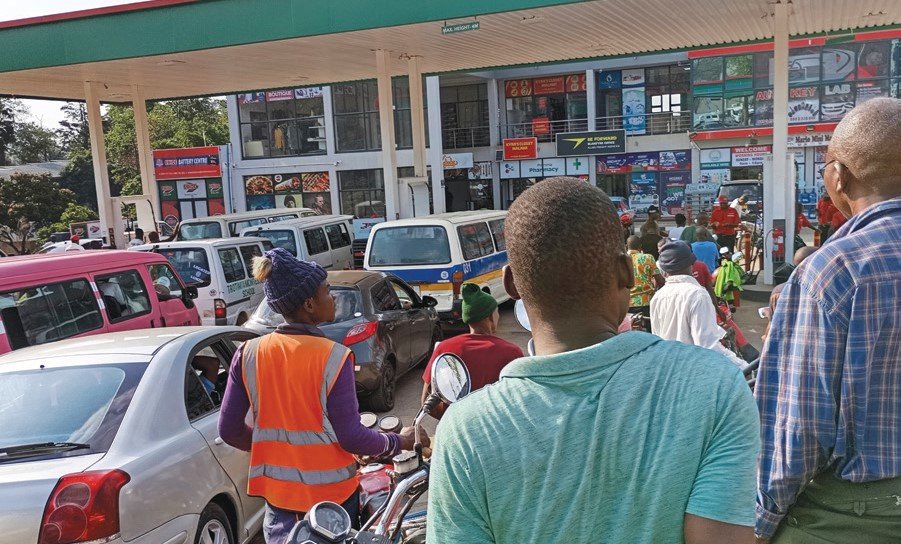
Barely hours after implementation of increased fuel pump prices and electricity tariffs, Malawians have started feeling the impact as service providers, mostl notably passenger transport operators have raised fares. The average 41 percent increase in pump prices of petrol and diesel as well as the 12 percent electricity tariff adjustment comes at a time the Malawi Government has rolled out a value-added tax (VAT) increase from 16.5 to 17.5 percent and introduced a new threshold on pay as you earn (Paye), which have eaten into salaries for low-income earners, wiping out their disposable income. Habson Simwaka travelled from Blantyre to Mzuzu at a cost of K70 000 en-route to Chitipa for a funeral, but when he returned to Mzuzu yesterday to connect back to his base in Blantyre, he was told to pay K100 000.
Fortunately, he negotiated and paid K90 000, but at a cost. “I am in debt already because I needed to find money to mark up the rise in transportation,” he said. At Engalaweni in Mzimba District, a hawker, Yamikani Chimdzakazi, said transport cost to Mzuzu where he orders merchandise from wholesales has jumped to K32 000 from an average of K20 000.
He said this adds to the rise in commodity prices from the adjustment in VAT. “I used to sell soya pieces at K950, but that changed to K1 000 after VAT. Now with transport, that has changed to K1 100,” he said, adding that transport was a major concern.
[paywall]
In Mzuzu Main Market, three leaves of rape are now fetching K500, down from six leaves previously. Vegetables vendor Catherine Manjolo, 40, a resident of Masasa Township in Mzuzu attributed the revised quantity to the increase in transport cost due to the fuel pump price hike. “I have six children, but cannot stop doing this, it is my survival,” she said.
In Lilongwe, transport fares from Area 25 to Old Town have doubled from K2 500 to K5 000 while the Nsanje-Blantyre route is now costing K25 000 per passenger from K150 00 and in Blantyre, the fare from Mbayani to Limbe has jumped from K1 500 to K2 500. Christopher Kumwembe, a barber at Safalawo in Ndirande Township in Blantyre, said with the 12 percent electricity tariff increase he has no option but to adjust upwards service prices. “We need electricity to operate and when Escom power goes off, we use petrol-powered gensets.
So we have nowhere to run; hence, raising the price. So, the minimum price for a haircut has moved from K1 500 to K2 500,” he said. Centre for Social Concern (CfSC) economic governance officer Agnes Nyirongo says for low-income earners, the current situation is distressing. She said low-income households spend a large proportion of their income on essentials such as food, transport, rent and energy.
[/paywall]
