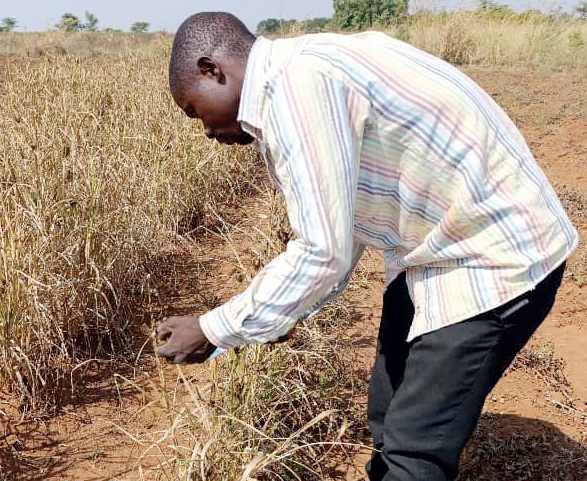
At dawn in a village near Chipala Extension Planning Area in Kasungu, Christina Constantin Mvula cups a handful of tiny millet seeds and lets them slip through her fingers. They look ordinary, yet they represent the possibility of food security, dignity and choice. For years, she has planted maize like nearly everyone else.
When the rains are kind, granaries fill. When they are not, hunger creeps in. But mawere (finger millet) is different.
So is bambara nut (nzama). These crops, once common in Malawian fields and kitchens, have quietly retreated to the margins of the country’s food system as seeds became harder to find. Lilongwe University of Agriculture and Natural Resources (Luanar) professor of plant breeding and genetics Moses Maliro notes that Malawi’s seed system has long been built around a narrow idea of what matters.
[paywall]
“Our seed system focuses on a few crops. Maize seed, for instance, is being produced by companies and it’s well certified,” he says. “But sole reliance on maize and other few crops perpetuates a lack of resilience in our food systems.” The problem is not maize itself, but what maize has come to represent: a single pillar holding up an entire house.
When that pillar cracks because of drought, pests or erratic rains, everything is at risk. The argument is simple. A household that grows diverse crops has several chances to survive a bad season.
If maize fails, millet or several others may succeed. Yet many alternative crops fall into a neglected and underutilised space with no progressive certification systems. Seed companies rarely multiply them.
Formal breeding pipelines seldom prioritise them. Farmers recycle seed from their own harvests; an age-old practice that is not without consequences. “Some of the seeds could be diseased or shrivelled, hindering prospects of healthy plants and higher yields,” Maliro says.
The result is a quiet erosion. Yields fall, farmers plant less and crops disappear from fields. Slowly, varieties that have survived for generations edge towards extinction.
In 2019, researchers decided to intervene, not by replacing farmers’ knowledge, but by standing alongside it. With support from the American-based McKnight Foundation, Luanar partnered with the Department of Agricultural Research Services (Dars) and extension officers to launch a project to strengthen farmer-managed seed systems. The work was piloted in Mzimba, Kasungu, Ntcheu and Chiradzulu not with predetermined solutions, but with conversations.
[/paywall]
