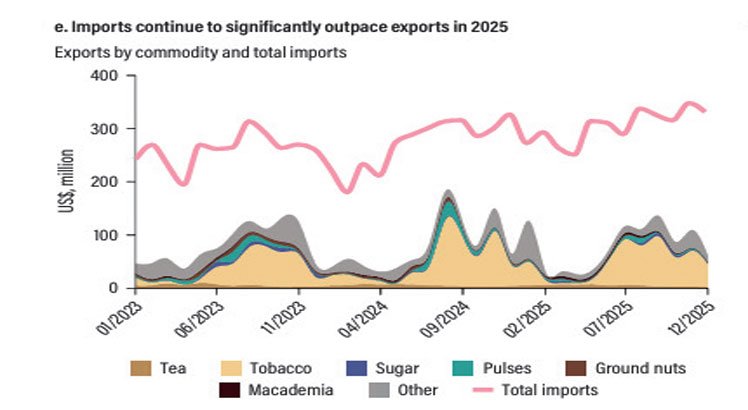
Malawi’s shrinking number of exporting firms has emerged as one of the key factors behind weak export performance, raising concerns about the ability of local firms to compete on the global market and generate foreign exchange. Finscope Micro, Small and Medium Enterprises (MSMEs) Survey 2025 data further show that the number of exporting firms declined by 47 percent from 1 227 in 2009 to 654 in 2025, reversing earlier gains recorded in the mid-2000s. The decline is most pronounced among manufacturing and primary commodity exporters, sectors policymakers view as central to diversifying Malawi’s narrow export base.
In an interview on Sunday, local entrepreneur Esther Manduwa, who runs a pure honey business, said many small firms begin with promising ideas, but struggle to grow beyond local markets. “What motivated me to start a pure honey business was the lack of quality honey on the market,” she said, noting that much of the honey sold locally contains sugar additives. However, Manduwa said bureaucratic hurdles and tax pressures often slow down the growth of small businesses.
“The process of registering the business most of the time takes long to finalise, which makes one to stick to the average customers available in our area or the circle that we have,” she said. Manduwa said tax incentives can help small businesses scale up production and eventually supply export markets. Thanthwe Farms chief executive officer Ngabaghila Chatata, in a separate interview yesterday, said limited access to long-term financing continues to constrain agricultural enterprises with export potential.
[paywall]
“Patient capital is what would build Malawi,” she said, arguing that long-term investments in agriculture require financing structures that allow businesses time to grow and access international markets. The survey further established that manufacturing exporters alone declined by 53 percent from 849 in 2009 to 399 in 2025, highlighting the erosion of the country’s industrial export capacity at a time authorities are trying to expand value-added exports. During the launch of of the 22nd edition of Malawi Economic Monitor, in February this year, World Bank country manager Firas Raad is quoted as having said that delays to implement reforms aimed at strengthening the export sector could worsen the country’s economic vulnerabilities.
“Delay is costly. Each month of elevated inflation, high deficits and low reserves erodes investor confidence and constrains policy choices,” he said. Raad said reforms aimed at restoring competitiveness should be embedded in a credible medium-term fiscal framework and implemented in a sequence that protects vulnerable households.
[/paywall]
All Zim News – Bringing you the latest news and updates.
