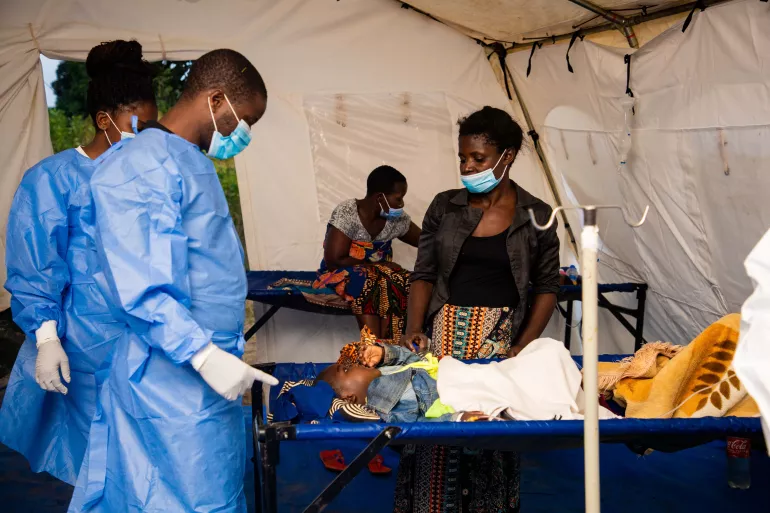
In Nathenje, on the outskirts of Lilongwe District, 31-year-old Lezina Aaron is still struggling to recover from the shock of losing two children to cholera within a week in 2023. After giving birth to her second child on January 7, Aaron and her newborn were admitted to Nathenje Health Centre, where the baby contracted cholera. At the same time, her seven-year-old son fell ill with the disease at home.
Her condition was critical. Placed on nearly 24 drips, she was too weak to breastfeed, even as her newborn desperately needed it. “When I regained some strength, the doctor came to my room to break the news,” she recalls.
“He told me my seven-year-old son had died of cholera. I couldn’t even attend his funeral.” Days later, her newborn—who had been referred to Bwaila Hospital in Lilongwe—also died. Aaron’s story reflects the growing human cost of climate-driven health crises, as floods, droughts and rising temperatures accelerate the spread of waterborne diseases such as cholera across southern Africa.
[paywall]
The climate–health link has gained global attention, including at the 30th UN Climate Change Conference (CoP30) in Belém, Brazil, where leaders warned that climate change is reshaping disease patterns. The Belém Health Action Plan calls for stronger surveillance and evidence-based responses to climate-sensitive diseases. For Malawi, which faces recurrent cholera outbreaks during flooding and heavy rains, the discussions reinforced the need to link climate adaptation with improved water, sanitation and hygiene (Wash) systems.
During the 2023 outbreak, hundreds of people died nationwide. Nathenje alone recorded 601 cholera cases and 41 deaths, with women the most affected. Facility in-charge at Nathenje Health Centre, Mary Lujere, says the outbreak exposed serious gaps in the health system.
“It was our first time experiencing such a severe outbreak. We lacked equipment, supplies and capacity,” she says. “Many cases could not be managed effectively.” In response, the facility began screening patients presenting with cholera-like symptoms, given the community’s limited access to safe water.
A 2024 Ministry of Health and Sanitation study shows that Malawi’s most severe cholera outbreak occurred in 2022/2023, with more than 53 000 cases and 1 586 deaths. Poor Wash conditions, worsened by extreme weather events, were identified as the main drivers.
[/paywall]
All Zim News – Bringing you the latest news and updates.
