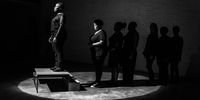
Minister Gayton McKenzie has been accused of contravening the right to freedom of expression after cancelling South Africa’s Venice Biennale submission, which deals with the Gaza genocide. In an astonishing clampdown on freedom of expression — and a break with the South African government’s official foreign policy stance on the Israeli genocide of Palestinians — Arts and Culture Minister Gayton McKenzie has cancelled a South African artwork proposed for the 61st Venice Biennale later this year because of content related to the deaths of women and children in Gaza. The decision, communicated by McKenzie on 2 January to the organising team preparing for the biennale, brings to an abrupt end a two-month-long open-call, selection and curatorial process, and places South Africa’s participation at the prestigious exhibition in Venice in jeopardy.
McKenzie took exception with Elegy, a work proposed by Gabrielle Goliath, who was unanimously selected as South Africa’s sole representative for the country’s pavilion. A 2019 Standard Bank Young Artist, Goliath is critically acclaimed both locally and internationally. For the biennale, Goliath’s proposed version of Elegy draws on her similarly titled decade-long project centred on femicide and the killing of LGBTQI+ people in South Africa, women killed by German colonial forces in Namibia during the Ovaherero and Nama genocide in the early 1900s, and the deaths of tens of thousands of women and children killed in Gaza by the Israel Defense Forces (IDF) since October 2023.
The third section includes a commemorative poem honouring the much-loved Palestinian poet Hiba Abu Nada, who was killed during the IDF bombardment of Gaza. According to letters McKenzie wrote to Art Periodic, the non-profit company tasked by the Department of Sport, Arts and Culture with organising and presenting the South African Pavilion at the 2026 edition of the biennale, it is the part of Elegy dealing with deaths in Gaza that the minister sought to censor. On December 22, he fired off a letter to Art Periodic requesting a change in curatorial and artistic direction by Goliath, the highly respected project curator Ingrid Masondo and team member James Macdonald.
Read Full Article on Daily Maverick
[paywall]
The minister also threatened to terminate South Africa’s participation in the biennale or withdraw the ministry’s support for the exhibition if his wishes were not acceded to. Without referring to the systematic killing of tens of thousands of Palestinians by IDF soldiers as a “genocide” — a termconfirmedmost recently by a United Nations independent international commission of inquiry in September 2025 — McKenzie described this subject matter as “highly divisive in nature and relates to an ongoing international conflict that is widely polarising”. Goliath, Masondo and Macdonald responded to McKenzie in a letter dated 4 January, in which they described the minister’s prescriptions to the artwork and threats to terminate participation in the biennale and/or withdraw government support for it as “an abuse of power and due process, and a contravention of the right to freedom of expression”.
“We do not believe it is the right or duty of a Minister — especially a Minister for Sport, Arts and Culture — to prescribe or constrain what artists, sports communities and the public can or cannot reflect upon or respond to. Doing so would foreclose the possibility of the arts to facilitate meaningful engagement with urgent and challenging sociopolitical concerns,” they continued. They further rejected the minister’s claims that their work was “highly divisive” or “polarising”.
Describing Elegy as a “work of mourning and repair”, they stressed its invitation to audiences “to relate empathetically with those commemorated through the performances, across lines of racial, gendered, geographic, religious and political difference. Drawing significant connections between the national disaster of femicide in South Africa, the Ovaherero and Nama genocide in Namibia, and the unfolding crisis of displacement and death in Gaza, it asks us to consider and refuse conditions that render some lives grievable and others available to death and disavowal.”
[/paywall]
